
Coptic is commonly treated as an Orthodox Christian language. In reality, it is the final stage of the Egyptian language, once spoken by the ancestors of Egyptian Muslims and Christians alike.
So how did Egypt lose it, and why are we teaching children about ancient Egypt without teaching them the language that connects it to Egypt today?
Ask most Egyptian students what language the ancient Egyptians spoke, and they will probably say “hieroglyphics.” But hieroglyphics are a writing system, not the name of the language itself.
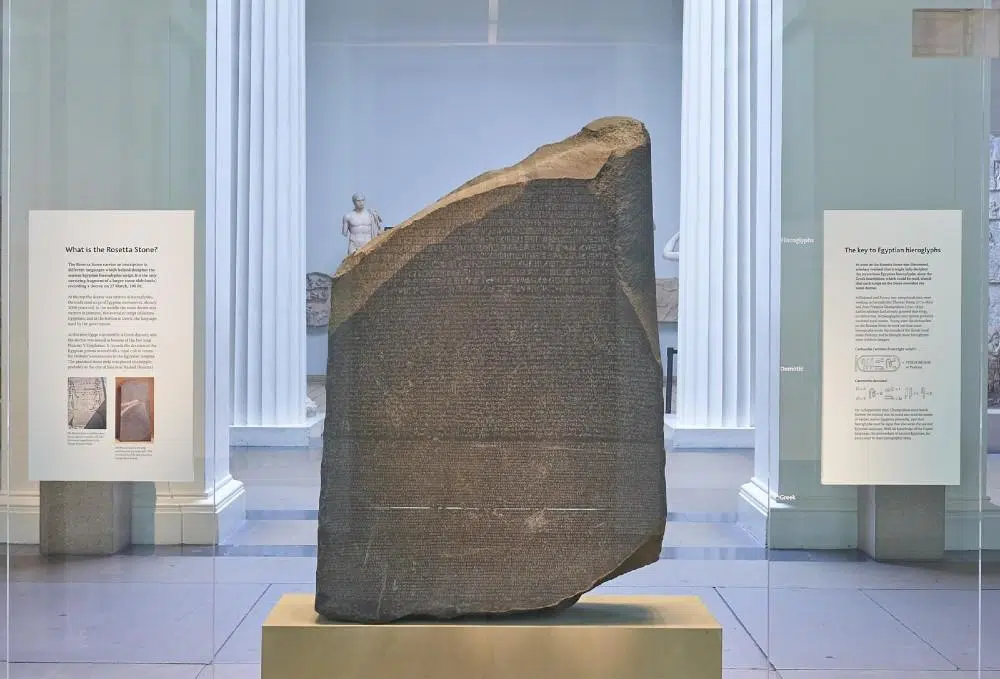
The Egyptian language continued developing for thousands of years. It was written in different forms, including hieroglyphic, hieratic, and Demotic, before reaching its final stage: Coptic.
Coptic was written mainly using the Greek alphabet, with additional letters taken from Demotic to represent Egyptian sounds that did not exist in Greek. Despite its Greek-looking alphabet and the many Greek words it absorbed, Coptic was still Egyptian.
And yet, most Egyptians now encounter Coptic almost exclusively inside Orthodox churches. It is heard in hymns and prayers, seen on religious icons, and discussed as part of Coptic Christian identity. This has created the impression that Coptic was always a Christian language and that it belongs specifically to Orthodox Christians.
Historically, neither assumption is entirely correct.
Coptic Was the Language of Egyptians, Not One Religion
Coptic did not suddenly appear when Egypt became Christian. The language developed over thousands of years in spoken Egyptian.
What Christianity helped popularize was its alphabetic written form. As Christianity spread across Egypt during the third and fourth centuries, Coptic was used to translate the Bible, preach to ordinary Egyptians, and produce religious and monastic literature. It was also used in letters, contracts, legal documents, tax records, and everyday communication.
This period produced a vast amount of Christian Coptic writing, which is one reason the language became closely associated with Christianity. But a language being used extensively by Christians does not mean it belonged exclusively to Christians.
Egypt was becoming increasingly Christian at the time, so much of what Egyptians wrote in their own language naturally reflected the religion of a growing majority.
Coptic was fundamentally the language of Egypt’s indigenous population. The ancestors of today’s Egyptian Muslims did not arrive as an entirely new population that replaced everyone who had lived here. Many were Egyptians who gradually converted to Islam, adopted Arabic, and eventually stopped being described as Copts.
They changed their language and religion. They did not lose their connection to the people who had spoken Egyptian before them.
Arabic Did Not Replace Coptic Overnight
The Arab conquest of Egypt in the seventh century is often presented as the moment Egyptians stopped speaking Coptic. In reality, the transition took several centuries.
The new rulers initially retained much of the existing Byzantine administrative system. Greek continued to be used in senior administration, while Coptic remained present in local records, contracts, correspondence, and legal documents.
According to an online exhibit by the University of Michigan Library, the documentary use of Coptic may even have expanded during the early Islamic period because it could be used for types of local documents that had previously required Greek.
The major shift began when Arabic became the required language of government and official records during the first half of the eighth century.
From that point, learning Arabic became increasingly necessary for anyone who wanted to work in administration, taxation, trade, law, or government. Arabic was the language of the ruling authorities, but it was also gradually becoming the language of social and economic opportunity.
Arabicization and Islamization Were Connected, but They Were Not the Same
The spread of Islam played an important role in the spread of Arabic. Arabic gave Egyptian converts access to the Quran, Islamic scholarship, government, and the wider Muslim community.
But conversion alone does not explain the disappearance of Coptic because Egyptian Christians also became Arabic speakers.
By the medieval period, Arabic was no longer simply the language of a foreign ruling class. Egyptian-born Muslims spoke it in cities, markets, and homes, while Christians increasingly adopted it in their daily lives and religious writing.
Coptic Christians began producing important books in Arabic because it was the language their own community understood. Arabic translations were added to Coptic manuscripts, and Arabic gradually entered church services.
By approximately the twelfth and thirteenth centuries, Coptic was no longer the ordinary language of most Egyptian households. It appears to have survived longer in parts of Upper Egypt and some rural communities, but there is no reliable date for the final native speaker.
So How Did Coptic Become an Orthodox Language?
The word “Copt” originally meant Egyptian. Over time, as more Egyptians converted to Islam, those who became Muslim gradually stopped being called Copts. The term remained attached to the Egyptians who continued practicing Christianity.
The Coptic Orthodox Church preserved the language’s manuscripts, grammar, hymns, pronunciation, and liturgy. Its monasteries and clergy kept Coptic in use long after it stopped being passed naturally between parents and children.
The connection between Coptic and Orthodox Christianity is therefore not imaginary. The Coptic Church deserves recognition for preserving a language that might otherwise have disappeared completely.
But preservation does not mean exclusive ownership.
Coptic remains part of a living Christian tradition, but it is also part of Egypt’s national and historical inheritance. Those two truths do not contradict each other.
Losing Coptic Meant Losing More Than a Language
There is something deeply sad about a country losing the ability to speak its own indigenous language.
Egyptian was not a minor language spoken briefly by one isolated community. It had one of the longest documented histories of any language in the world, developing across thousands of years before reaching its final stage in Coptic.
Then that continuity was broken.
Mourning the loss of Coptic does not mean rejecting Arabic or blaming Egyptians for adapting to the realities around them. But understanding why the change happened should not stop us from recognizing its scale.
Egyptians did not need to abandon Coptic to become Muslim. Iran remained Persian-speaking, Turkey kept Turkish, Indonesia speaks Indonesian, and Bangladesh speaks Bengali. These countries adopted Islam while continuing to speak their native languages. Arabic remained central to prayer and religious study without necessarily replacing the language spoken at home.
With that said, over generations, Egyptians adopted Arabic not only as a religious or administrative language but as their own. Arabic became genuinely Egyptian, but that does not make Coptic’s disappearance any less significant.
We lost the ability to hear our history in our own voices. We became a country surrounded by the remains of its ancestors but unable to understand the final form of the language they passed down.
Coptic survived on church altars, in manuscripts, and through hymns memorized across generations, but it stopped belonging to ordinary Egyptian life.
Today, Egypt celebrates its ancient civilization constantly. We build museums for it, promote it internationally, reproduce its symbols on everything, and teach children to feel proud of it. Yet most Egyptians cannot read a basic Coptic sentence or recognize the connection between Coptic and the language spoken in ancient Egypt.
Many do not even know that connection exists.
An uncomfortable contradiction exists in treating ancient Egypt as the foundation of our national identity while treating its surviving language as a specialized religious subject.
We proudly claim the civilization, but we have distanced ourselves from the language that connects it to us.
Recognizing Coptic as national heritage does not diminish the Christian community’s relationship with it. The language survived precisely because the Coptic Church protected it when almost every other institution had stopped using it.
We cannot reverse centuries of language change or expect Egyptians to abandon Arabic. But we can decide that losing Coptic as a spoken language does not have to mean losing all knowledge of it.
Why Coptic Belongs in Egyptian Schools
Egyptian students spend years learning about ancient Egyptian temples, kings, tombs, and gods. They memorize dynasties and look at hieroglyphic symbols. But they are rarely taught what happened to the Egyptian language afterward.
This creates an artificial separation between ancient and modern Egypt. Ancient Egyptians are presented as a fascinating but vanished civilization, while the Coptic period is often reduced to a religious chapter assumed to concern Christian students more than Muslim students.
Teaching Coptic would help repair that broken continuity.
It would help students see that Egyptian history did not end with Cleopatra, the Roman conquest, or the arrival of Christianity. The language continued to develop, absorb outside influences, and be spoken by Egyptians for centuries.
Teaching Coptic does not mean adding another difficult subject that students must memorize for exams, nor does it mean expecting every Egyptian child to become fluent.
Schools could begin with the Coptic alphabet, basic vocabulary, simple sentences, and the development of Egyptian from its ancient forms into Coptic. Students should also encounter letters, contracts, and ordinary historical texts so they understand that Coptic was once a language of everyday Egyptian life, not only religious prayer.
Egypt does not need every student to speak Coptic fluently. It needs every student to understand what the language is, where it came from, why it disappeared, and why it belongs to them.
We already teach children to be proud of the civilization their ancestors built. It is time we also introduced them to the language those ancestors left behind.


