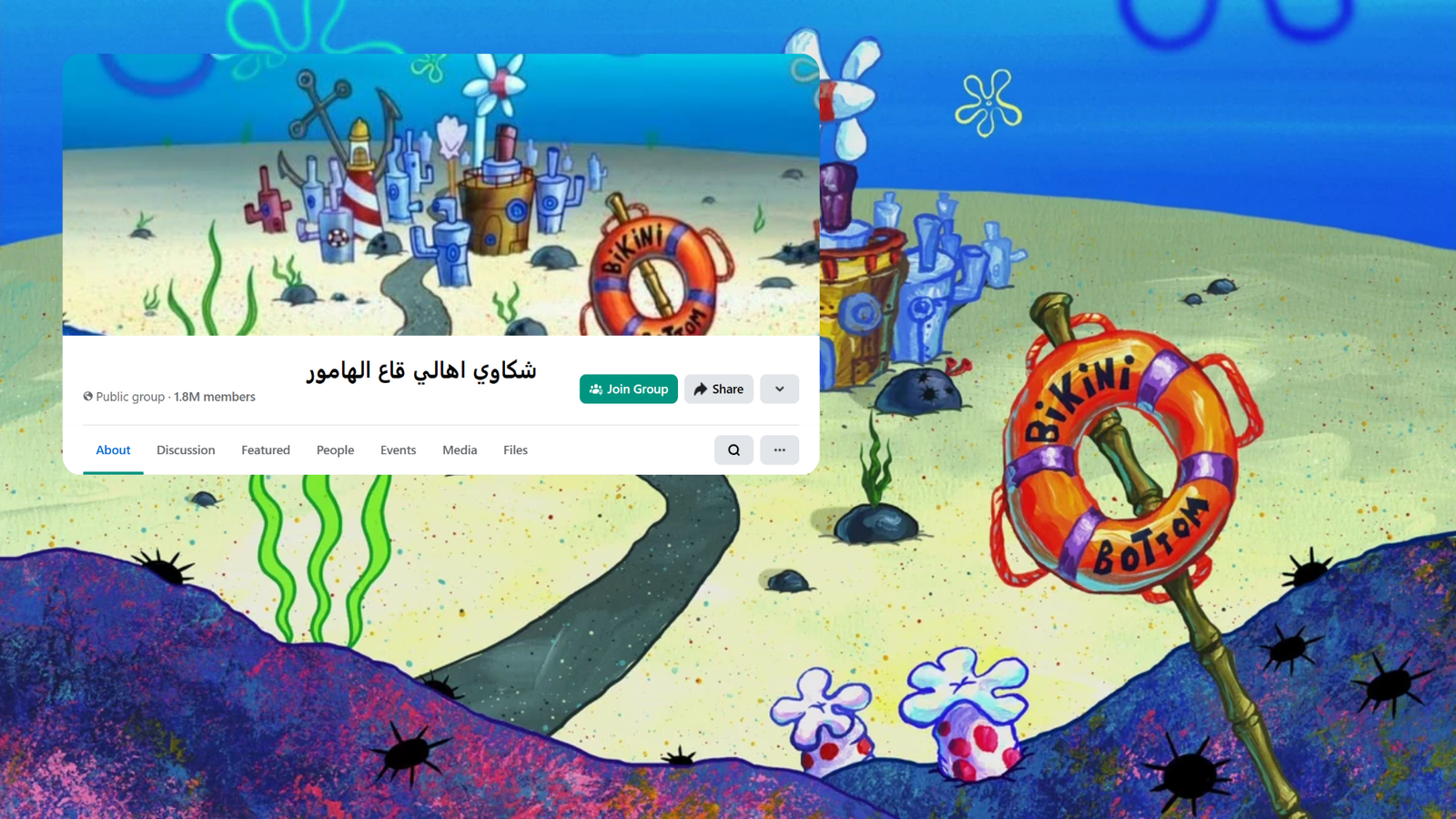
From a SpongeBob joke to a politically charged trend, Qa3 El-Hamour quickly became more than just internet chaos. But what’s actually behind the rumors, accusations, and agendas?
So, What Is Qa3 El-Hamour?
“Qa3 El-Hamour” is the name being used for Bikini Bottom, the fictional underwater city from SpongeBob SquarePants. The trend began with a Facebook group called “Shakawy Ahaly Qa3 El-Hamour,” which roughly translates to “Complaints of the Residents of Qa3 El-Hamour.”
The idea was simple and, initially, completely unserious.
Instead of posting about everyday problems in a normal neighborhood group, people started posting them as residents of Qa3 El-Hamour. Complaints, local drama, businesses, promotions, relationships, and random observations were all given the SpongeBob treatment.
It was essentially an Egyptian neighborhood group, except the neighborhood was underwater.
How Did It Grow This Fast?
The group was created on August 11 and grew at an unusually fast pace, crossing one million members within roughly two weeks. By the time we’re publishing this, it had reached 1.8 million members, turning Qa3 El-Hamour from a funny Facebook group into a genuine social media phenomenon.
As more people joined, more content was created, making the trend increasingly visible beyond the first group across Facebook, Instagram, and other platforms. It quickly became self-sustaining.
The trend soon spread far beyond the first group. Users began creating AI-generated images that placed Egyptian celebrities, businesses, streets, and everyday situations inside Bikini Bottom. Instead of one person making a meme and everyone else sharing it, thousands of users were effectively building the same fictional world together.
The result was a strange parallel version of Egyptian society, complete with restaurants, workplaces, neighborhood disputes, celebrities, and complaints. With AI making it easy to create new images, there was almost no limit to how far the joke could go.
Celebrities eventually joined in, giving the trend another push and helping Qa3 El-Hamour evolve from a Facebook community into a wider Egyptian social media phenomenon.
So When Did It Become Political?
This is where the story starts getting more complicated.
As Qa3 El-Hamour became increasingly popular, people began questioning why the group had grown so quickly and who was behind it. At the same time, some users began using the trend itself to push political agendas, turning a fictional neighborhood into a space for political commentary, accusations, and arguments.
That opened the door for a second wave of claims that the trend was not simply a viral joke, but part of something more organized.
One of the biggest rumors circulating online was that the group had connections to the Muslim Brotherhood. Posts and discussions started to present this as an explanation for its sudden growth, whereas others claimed that “Shakawy Ahaly Qa3 El-Hamour” (Citizen complaints of Bikini Bottom) had existed under different names before becoming the group people know today.
But this is where the distinction between a trend becoming political and a trend being created as a political project becomes important.
The fact that people later used Qa3 El-Hamour to promote political agendas does not, by itself, establish that the group was created for that purpose.
Then, of course, some jumped on the bandwagon and decided to start rumors that the group was renamed and claimed it was run by the Muslim Brotherhood.
What Does the Group’s History Actually Say?
The publicly visible history of the current Facebook group shows that it was created on August 11.
There is no documented history of name changes indicating that this same group previously operated under the different names circulating online.
That matters because some claims present an alleged previous identity for the group as established history.
In one specific claim, the Deputy Editor-in-Chief of Egyptian news platform Newsroom, interviewed by Tamer Abdelmonem on his television program El-Basma, said the group had previously operated under several names dating back to 2018, including names referencing Al-Azhar. The platform also published the claim with screenshots that we failed to verify.
That does not tell us everything about the people behind the group, nor does it establish anything about their personal or political affiliations. It simply means the specific claim that the current group previously operated under a series of different names since 2018 is not supported by the group’s publicly visible history.
The Group’s Owner Responds
The group’s owner, who is 15 years old, has also addressed the growing conspiracy theories surrounding Qa3 El-Hamour, dismissing claims that the group is connected to terrorism or any organized political activity.
In a video, she said the group was created as a joke between her and her friends, all of whom are 15 years old. She also said many of the more extreme posts circulating online are not necessarily from the group’s official community, as several other pages and groups have used the same name. (screenshot)
She rejected claims that the group has a hidden agenda, saying the people behind it have nothing to do with the accusations made online and asking users to treat the trend as it originally was: a joke.
However, The Political Claims Are Still Growing
The trend then took another unforeseen turn when a Facebook page presenting itself as the “Official Ministry of Interior page in Qa3 El-Hamour” appeared online. The page was later shut down, introducing another layer to a trend that had already moved far beyond its original SpongeBob joke.
This is where two things can be true at the same time. Qa3 El-Hamour may have started as a joke, but the conversation around it is still becoming political.
As the trend grew, people began using the fictional setting for political commentary, arguments, and accusations. Others began interpreting the group’s rapid growth as evidence of something more organized behind it.
This, however, does not mean it was created for any political agenda. The political allegations came after the trend had already begun attracting massive attention.
So, Are We Ever Allowed to Have Nice Things?
Apparently, not even SpongeBob is safe.
What started as Egyptians collectively pretending that Bikini Bottom was just another neighborhood group quickly became a much bigger internet phenomenon. And once millions of people are participating in anything, especially something built around satire and fictional institutions, the line between parody, commentary, misinformation, and political interpretation can get very blurry.
That does not mean every political claim surrounding Qa3 El-Hamour is true. It also does not mean every piece of content posted under its name reflects the founding group’s intentions.
It does mean the trend has moved beyond being just a meme, with political stories attached to it and authorities now being asked to examine some of the activity taking place under its name.
It went so far as to become an official legal issue. Today, on August 23rd, lawyer Ashraf Nagy filed what Cairo 24 reported as the first complaint to the Public Prosecutor concerning the Qa3 El-Hamour groups, pages, and accounts.
According to the report, the complaint calls for an investigation into those responsible for creating, managing, funding, or producing content for accounts associated with Qa3 El-Hamour, particularly where the content may have gone beyond satire and into imitation of official institutions.
The complaint cites pages and accounts using names such as “Qa3 El-Hamour Police Station”, “Ministry of Interior”, “Qa3 El-Hamour Court of Cassation”, and “Qa3 El-Hamour Court”, as well as accounts focused on complaints, elections, services, and real estate.
The complaint itself does not establish that a crime has been committed. It asks authorities to examine whether any of the activity crossed the line from parody and satire into conduct that could carry legal liability, including impersonating official entities, spreading false information, or creating confusion about the identity or authority of those operating the accounts.
This begs the question: if this becomes an actual legal issue, who’s responsible? The 15-year-old girls trying to have fun, or those who push everything to make it political? Or maybe those who are blatantly lying and claiming it’s actually political?
For now, the clearest picture is that Qa3 El-Hamour began as an absurdly Egyptian take on a fictional cartoon neighborhood, grew to an enormous size in an unusually short time, and was later drawn into political arguments, agenda-driven narratives, rumors, and judicial review.
The joke may have started underwater, but the conversation remains afloat.