
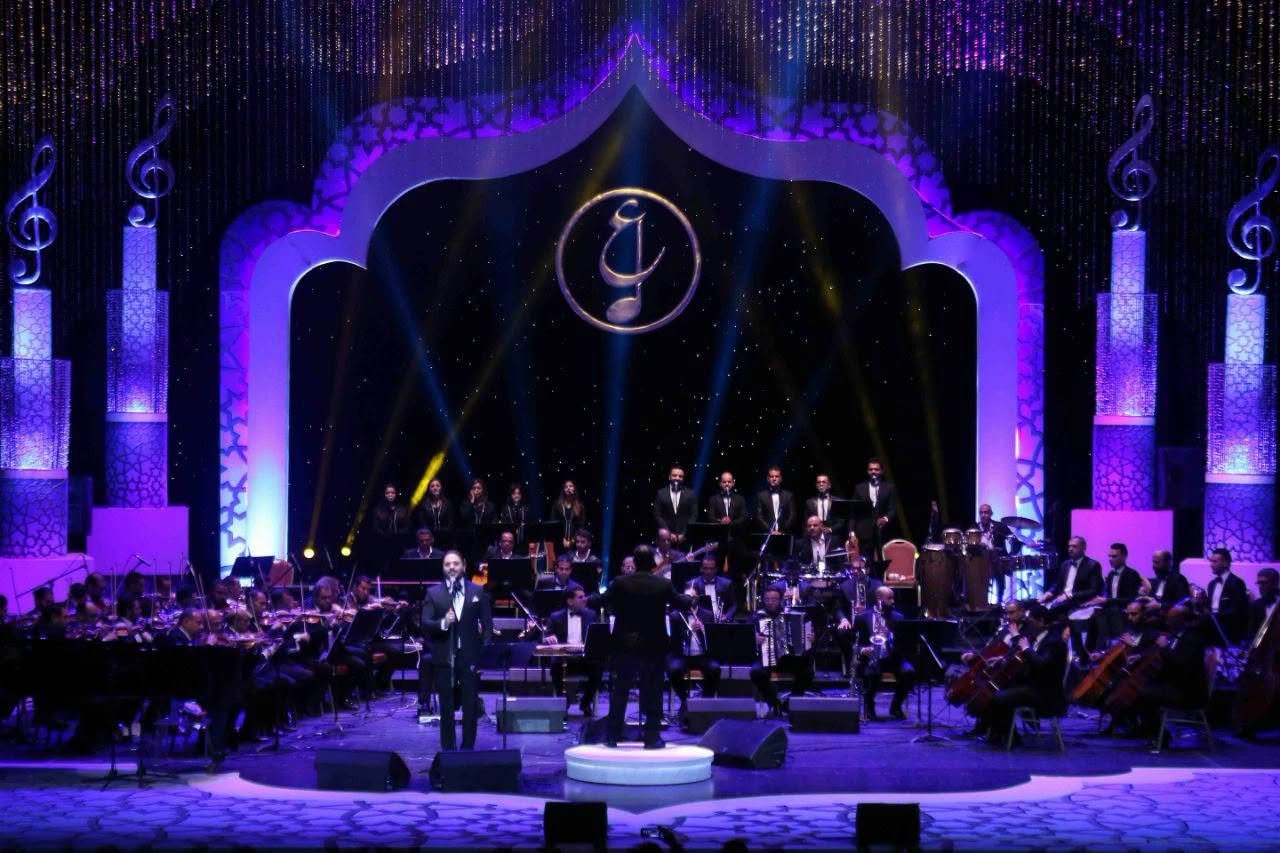
There is a certain irony in what has happened to the Arab Music Festival over the last 24 hours.
A festival struggling with funding and questions over its marketing has suddenly received more publicity than it could probably buy. Unfortunately, it has been about resignations, withdrawals and public disputes instead of the music.
It started during the press conference announcing the festival’s 34th edition, when Egyptian Opera House President Reda El-Wakil was asked why several major Arab singers were missing from the lineup, and his answer was money.
El-Wakil said the festival doesn’t have the financial resources available in some other countries, adding that several participating artists had already reduced their fees.
But the comment quickly opened up a much bigger conversation about how the festival is funded, marketed and managed, and how the artists and musicians involved are being treated.
Within hours, major figures in Egyptian music were publicly challenging El-Wakil’s explanation, while others began revealing why they weren’t participating in the festival at all.
This Wasn’t Just About One Bad Quote. The Artists Had Something to Say Too.
The comment about other countries having more money understandably became the headline, but what followed exposed a much bigger argument.
Conductor Hany Farhat, who previously headed the festival, challenged the idea that money alone explains the problem. His argument was that during his tenure, major artists participated without demanding enormous fees and that sponsorship and proper marketing could help finance the festival.
Then Ali El-Haggar explained why he would not participate this year.
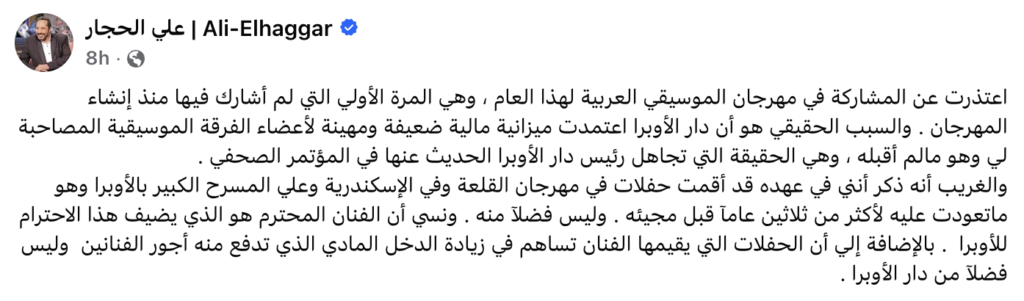
El-Haggar said this would be the first edition he had missed since the festival began and disputed the explanation given at the press conference for his absence. According to him, the issue was the budget allocated to his musicians, which he described as “weak and humiliating.”
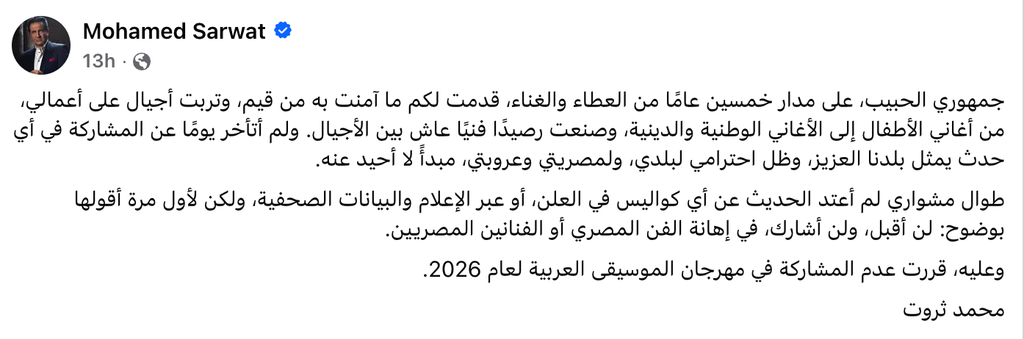
Mohamed Tharwat then announced that he was withdrawing from the festival altogether, saying he would not participate in what he considered an insult to Egyptian art and Egyptian artists.
And then came El-Wakil’s resignation.
El-Wakil announced that he would not continue as president of the Egyptian Opera House. His statement also suggested another layer to the dispute, saying that he would not accept interference in his choice of an Egyptian artist whom he supported and believed in.
Who exactly was interfering, which artist he was referring to and how that dispute connects to everything else remains unclear from the information publicly available so far.
So no, this isn’t really a story about one badly received sentence anymore.
It’s a story about how one of Egypt’s most important music festivals is being managed, funded, marketed and valued.
And That’s the Actual Shame Here
The Arab Music Festival shouldn’t be a minor event that suddenly becomes interesting when everyone starts fighting.
This is its 34th edition.
It is scheduled to run for 11 days, with 22 concerts and around 70 Egyptian and Arab artists, alongside its academic conference and cultural program.
More importantly, the idea behind it has enormous potential.
Egypt has spent more than a century at the center of modern Arab music. The country’s musical history isn’t something sitting exclusively in museums or old recordings. It continues through singers, composers, musicians, orchestras, conservatories, venues and an audience that still knows and loves this music.
A properly developed Arab Music Festival could be a major annual cultural event.
It could introduce younger audiences to musicians they only know through their parents. It could bring major Arab artists to Cairo. It could celebrate contemporary musicians alongside the enormous archive of Egyptian and Arab music. It could create collaborations, conversations and performances that don’t happen anywhere else.
And yes, it could be marketed.
If funding is genuinely a problem, then the conversation can’t stop at “we don’t have money.”
That raises another question: why doesn’t something with this much cultural history attract more sponsorship, partnerships and commercial interest?
Why don’t these entities hire a better marketing team? Do they even have one? Because if they do, they need to fire them immediately.
That’s essentially part of the argument Hany Farhat made after the press conference: funding does not have to mean relying exclusively on the Opera’s available budget. Sponsorship and marketing are part of running a major cultural festival too.
And perhaps that’s the greatest irony of this entire mess. The Arab Music Festival has just proved that people will pay attention to it.
Within hours, artists were issuing statements, musicians were arguing publicly, entertainment pages were covering every development and audiences who probably hadn’t seen the original festival announcement suddenly knew exactly what was happening.
Imagine if even part of that attention had been generated by the actual festival, and people were debating the lineup instead of the resignation.
Imagine if the viral posts were about a performance everyone wanted tickets for rather than who had just withdrawn.
We Should Be Treating This Like the Cultural Institution It Could Be
None of this means pretending that a public cultural institution has unlimited money.
It obviously doesn’t.
And it doesn’t mean every major Arab singer can or should be booked regardless of cost.
But there is a very large distance between “we cannot compete financially with every entertainment market in the region” and accepting that one of Egypt’s major musical institutions should simply operate with limited resources, weak promotion and recurring disputes over what musicians are being paid.
Egyptian and Arab music deserve better than that.
The musicians deserve better than that.
And the audience deserves a festival that feels like an event worth waiting for every year.
The Arab Music Festival is still scheduled to begin on October 20. The program has not been cancelled, and dozens of artists remain involved.
So hopefully, by then, we’ll actually be talking about the music.
It’s a damn shame.


