
After upgrading to the iPhone 18 Pro, I wanted to answer a much simpler question than you’ll find in most technical reviews: Is it actually worth buying?
Buying a new iPhone in Egypt isn’t exactly an impulse purchase anymore. When you’re spending this much money on a phone, upgrading isn’t just about wanting the newest model. You want to know whether you’re actually getting something significantly better for your money, particularly if you already have a relatively recent iPhone.
For context, my personal phone before this was an iPhone 16 Pro, while our work phone is an iPhone 17 Pro, so I’ve been able to use all three side by side. I’ve also been an iPhone user since the iPhone 4, which unfortunately means Apple has had more than enough time to trap me in its ecosystem.
And after using the 18 Pro, my answer is complicated.
First: It Feels Really, Really Good
The iPhone 18 Pro feels noticeably better in my hand. The size feels almost perfect, and strangely, even though I can’t look at the 17 Pro and 18 Pro and immediately identify some dramatic difference in dimensions, the 18 Pro simply feels better to hold.
Sometimes you want a new phone because you need one. Sometimes you also want the pretty new color. And yes, I’ll admit another extremely important reason I wanted it: the burgundy one looks sexy as hell.
My actual reason for upgrading, however, was much more boring: storage.
My iPhone 16 Pro only had 128GB, and even with iCloud, I was constantly fighting for space. At some point, upgrading the storage became less of a luxury and more of a necessity.
And with several retailers and banks now offering installment plans, including zero-interest options depending on the provider, selling your old phone and spreading the remaining cost can make upgrading significantly more manageable.
But if storage hadn’t been an issue? I’m not convinced I would have upgraded.
Performance: Yes, It’s Faster. Does That Matter? Not Really.
Apple’s A20 Pro is obviously more powerful on paper, and Apple is making some very big performance claims about this generation.
In normal everyday use, though, the difference isn’t dramatic.
The 18 Pro feels a little faster than the 17 Pro and 16 Pro, but those phones were already fast. Apps already opened quickly. Scrolling was already smooth. Normal everyday tasks weren’t exactly pushing either phone to its limits.
Unless your usage regularly pushes an iPhone particularly hard, the performance improvement isn’t something I’d upgrade for.
Battery: I Expected More
Apple advertises up to 24 hours of “typical use” for the iPhone 18 Pro and up to 36 hours of video playback. That hasn’t reflected my experience.
Yes, the battery currently feels better than my older phones, but it’s also a brand-new battery. In actual daily use, I’m still managing to kill the phone before the end of the day.
For a phone this expensive, and considering how heavily battery improvements are marketed every year, I expected more.
The Vapor Chamber Doesn’t Mean Your Phone Won’t Get Hot
This was one of the upgrades I was genuinely excited about. Apple redesigned the vapor chamber for the iPhone 18 Pro, giving it three times the surface area of the previous generation, with the goal of improving heat dissipation and sustained performance.
That sounded fantastic, and I expected a significantly cooler phone, but that’s not what I got. Even without a case or screen protector, the iPhone 18 Pro still gets noticeably hot.
In my experience, it heats up less than our 17 Pro; that was always burning like it was covered in rain from hell. What surprised me is that it still gets noticeably hotter than my 16 Pro.
The important distinction here is that Apple’s vapor chamber is designed primarily to help the phone manage heat and sustain performance, not magically prevent it from generating heat altogether.
Still, from a user’s perspective, if you were expecting the new cooling system to mean you’ll stop feeling your iPhone heating up in your hand, that’s definitely not my experience.
The Camera Is Better, But This Is Where Things Get Complicated
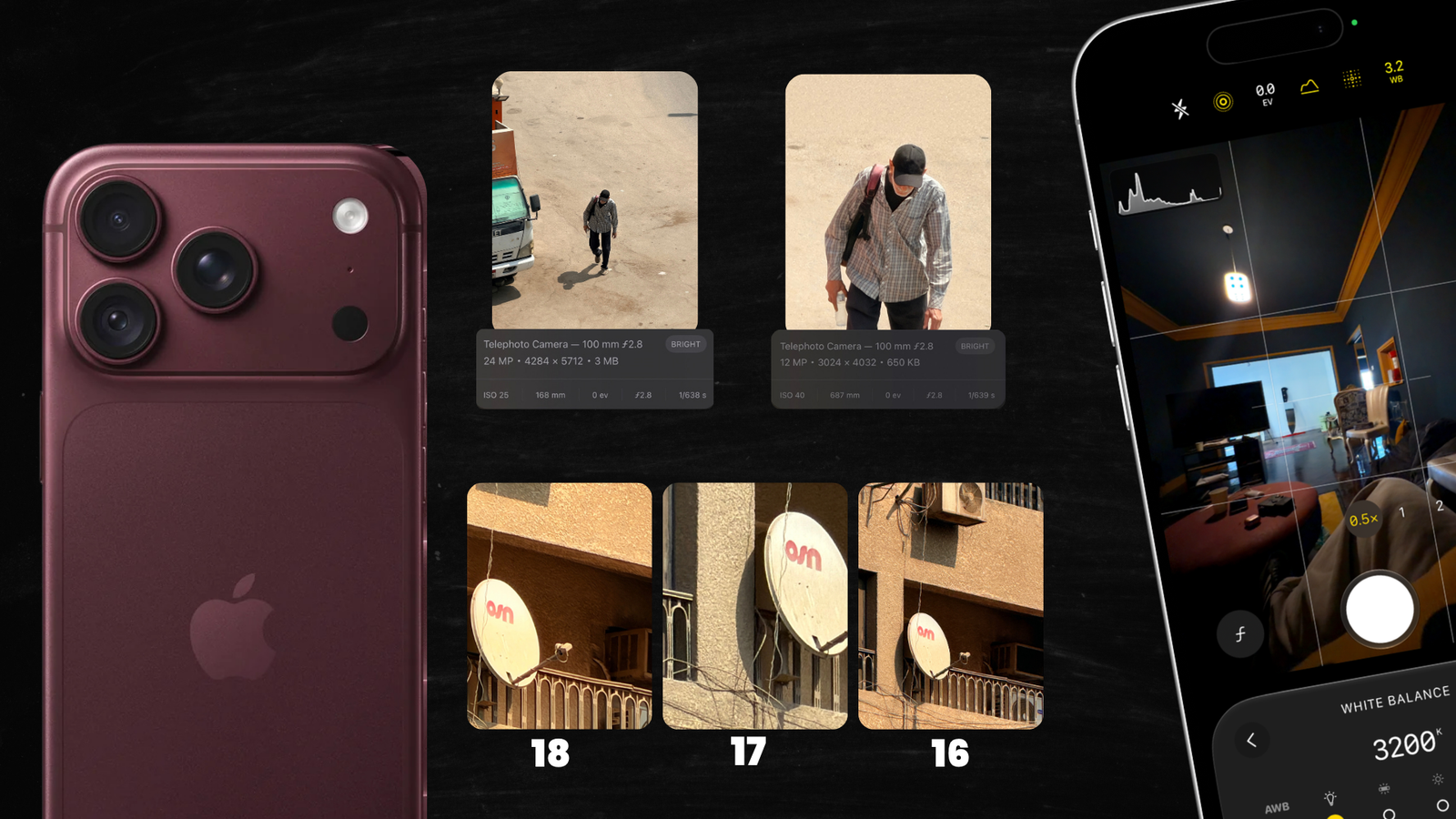
The camera is probably where I’ve spent the most time comparing the three phones. There are improvements, and some of them are genuinely useful.
The biggest improvement for me isn’t necessarily image quality. It’s control.
Apple finally lets you manually control things including shutter speed, white balance and aperture directly through its Pro controls, and this was badly needed.
Third-party manual camera apps have existed forever, but I’ve always found them clunky compared to having those controls directly inside the native Camera app.
The automatic white balance also seems noticeably better in my testing. That’s something I immediately appreciated. I did, however, not like the skin tones on it. I much prefer the skin tones on the 16 Pro. The 17 Pro always showed blue hues in the skin tones, and I didn’t even compare them.
But What Happened to the Photographic Styles?
This was one of my least favorite parts of the camera experience.
Some of the Photographic Styles on the 18 Pro look extremely artificial, particularly when it comes to skin.
My first photo genuinely scared me because I thought this was simply how the new camera processed faces. The skin looked aggressively retouched in a way that reminded me of the beauty filters traditionally associated with some cheaper Chinese smartphone cameras.
Thankfully, it can be changed.
But the fact that my first reaction to a new Pro iPhone camera was “What happened to my face?” isn’t exactly ideal.
Apple has expanded Photographic Styles on the 18 Pro with new controls for texture, grain, color, and skin appearance, so there’s considerably more customization available.
Once you adjust everything to your preference, it’s fine. But I definitely wasn’t a fan of the initial look.
The Selfie Camera Is Actually a Big Upgrade
Now we get to one camera upgrade that I can genuinely see being worth it for certain people.
The front camera is excellent.
The 18 Pro has an 18MP Center Stage front camera, and while I personally don’t use the selfie camera enough for it to influence my purchasing decision, people who regularly shoot themselves, create content using the front camera, or simply take a lot of selfies are going to notice this upgrade.
Comparing the rear cameras between the 16 Pro, 17 Pro, and 18 Pro mostly became a game of tiny differences and nitpicking.
The selfie camera was much easier to appreciate.
The Zoom Comparison Had an Unexpected Winner
One of the biggest surprises from comparing all three phones wasn’t how much better the 18 Pro was.
It was realizing how much I disliked the digital zoom on the 17 Pro.
The 18 Pro was better, as expected. But surprisingly, I also preferred results from my 16 Pro in certain comparisons.
The 16 couldn’t get as close, but the image itself looked better to me.
That’s an important distinction because smartphone manufacturers increasingly sell us on how far cameras can zoom. But getting closer to something doesn’t automatically mean you’re getting the better photograph.
The 18 Pro officially offers up to 8x “optical-quality” zoom and up to 40x digital zoom.
Personally, I’d still rather have a cleaner image than a bigger number.
The Variable Aperture Was My Biggest Disappointment
This should have been the feature I loved. The iPhone 18 Pro introduces a physical variable aperture on its main camera, with settings of f/1.48, f/1.8, f/2.8, and f/4. Apple says this allows the camera to physically control light and depth of field rather than relying entirely on computational photography.
As someone who regularly shoots with actual cameras, I was extremely excited to test this.
Aaaaand I’m underwhelmed…
Yes, there are differences when you start deliberately looking for them. But the difference isn’t nearly as dramatic as I expected from a physical aperture system.
I wasn’t suddenly getting the kind of natural separation or beautiful circular bokeh that I associate with shooting a fast lens on a dedicated camera.
The images still somehow feel computational. Maybe that’s an unfair comparison. An iPhone is still a phone with a tiny camera system, not a Sony mirrorless camera with a fast lens attached to it.
But Apple is specifically selling aperture control as one of the headline features of this generation. As someone who actually cares about aperture, I expected it to excite me more than it did.
It didn’t.
And Then There’s Face ID
This has been my biggest actual problem with the phone. Face ID has been unreliable for me.
I’ve tried setting it up multiple times, and the phone still regularly fails to recognize me. I’ve tested it without a screen protector or anything obstructing the camera, and the problem persists.
Apple’s current troubleshooting guidance recommends updating iOS, checking that nothing obstructs the TrueDepth camera, resetting Face ID and setting it up again, among other steps.
I’ve already tried setting mine up repeatedly, so for now I’m hoping this turns out to be something that can be improved through software updates.
But on a phone at this price, having to repeatedly type my passcode because Face ID doesn’t recognize me is incredibly frustrating.
So, Should You Buy the iPhone 18 Pro?
After using it alongside the 16 Pro and 17 Pro, I don’t think the iPhone 18 Pro feels like a major upgrade if you already own either of them.
It’s a very good phone. That’s not really the question. The question is whether the improvements justify spending this much money on another phone.
For me, they don’t.
I upgraded because I desperately needed more storage, and because apparently burgundy is enough to destroy my financial judgment. If my 16 Pro had more storage, I genuinely don’t think I would have upgraded.
If you’re coming from a significantly older iPhone, that’s a different conversation. You’re getting several generations of improvements at once, so the jump will naturally feel much bigger.
But if you’re holding a 16 Pro or 17 Pro right now, wondering whether you’re missing out?
You’re really not missing much.
And maybe it’s time to move on from iPhones in General
For the first time after buying a new iPhone, I’ve found myself wondering whether I should have bought a Google Pixel instead.
That’s probably the bigger problem Apple has right now.
I’ve been using iPhones since the iPhone 4. My devices, accounts, files, and workflows are built around Apple’s ecosystem, and leaving it would be inconvenient enough that I keep buying another iPhone.
But if you’re buying a flagship phone today and aren’t already heavily invested in Apple’s ecosystem, I wouldn’t automatically assume an iPhone should be your next phone.
Android flagships have changed enormously, and many of the problems that once made switching from an iPhone feel like a compromise simply aren’t the same problems they used to be.
The iPhone 18 Pro is good.
I’m just no longer convinced that “good” is enough reason to spend this much money on it.


