
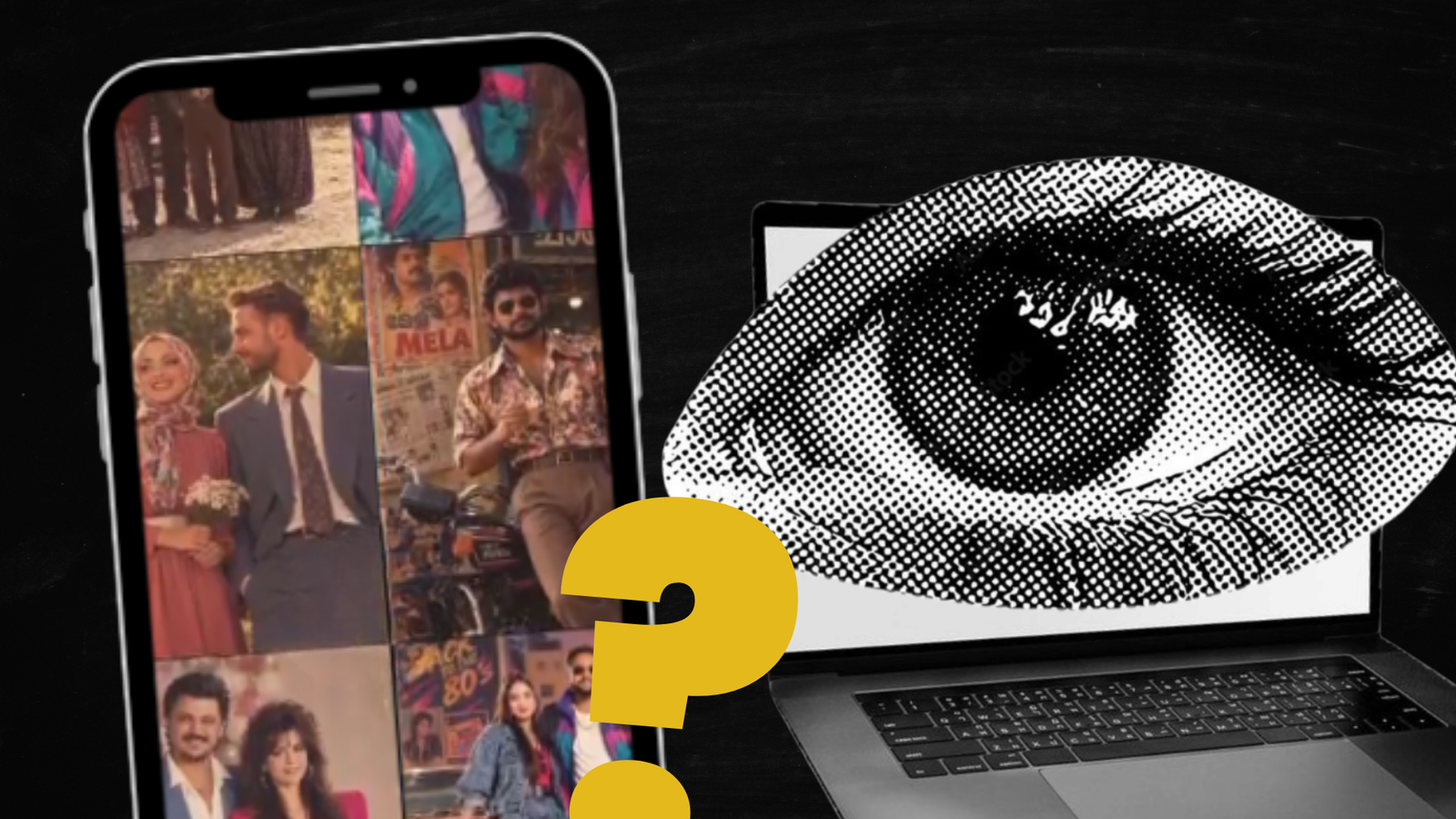
Right now, everyone’s going back to the ’80s in the new 80s AI Photo trend.
They’re fun, they’re easy, and we’re probably not going to convince you not to do them. But before you upload five photos of your face to an app you discovered 30 seconds ago, there are a few things worth knowing.
1. That AI photo uses actual water, and we mean A LOT of water
According to the United Nations University Institute for Water, Environment and Health, generating a typical AI image has an electricity-associated water footprint of around 29 mL, roughly two tablespoons of water.
You might think one photo won’t hurt, but it does. You probably generate several versions before finding one you like. Then millions of other people do the same thing. Then another AI trend comes along, and everyone starts again.
The same UN report estimates that by 2030, the water footprint from global data-center electricity consumption could reach 9.3 trillion liters.
So no, your ’80s photo isn’t single-handedly draining the planet. But it isn’t environmentally free either.
2. Ask yourself: who actually made this app?
This happens almost every time an AI trend goes viral. It starts with a ChatGPT prompt, then suddenly, there’s an app or website you’ve never heard of promising to create exactly the image everyone is posting.
Before uploading anything, spend two minutes finding out who you’re actually giving your photos to.
Who owns the service? Is it an established company? Does it have a proper privacy policy? Where is the company based? Is there a clear way to contact them?
Just because everyone else is using an app doesn’t automatically make it trustworthy.
3. Your innocent selfie can become source material for something much less innocent
AI can now take an ordinary photograph of a real person and use it to create convincing fake images, including sexually explicit deepfakes.
AI companies increasingly need lawfully obtained data and clear rights to use it, especially as regulators, courts, and rights holders scrutinize how AI training material is collected and used. That makes legitimate datasets increasingly valuable.
So when an unknown app asks you to upload five, ten, or twenty clear photographs of your face, don’t assume those files become worthless the second your funny ’80s portrait is generated.
Depending on the terms you agreed to, you may have granted the service certain rights to store, process, or use your uploads.
That doesn’t mean the app is going to make deepfake porn of you. But once you’ve handed over your photographs, what can legally and technically happen to them depends heavily on the permissions you gave the service.
And clicking “I agree” without reading them doesn’t make those permissions disappear.
The scary part isn’t knowing that every app will misuse your photos.
It’s not knowing what you just gave an app permission to do with them.
4. So, yes, you really MUST read the privacy policy
We know, nobody wants to. But you’re not uploading a random document. You’re uploading clear photographs of your face.
Look specifically for what the service says about how long your uploads are stored, whether they’re shared with third parties, whether they can be used to improve or train AI systems, what license you’re granting over uploaded content, and whether you can permanently delete your data.
Not every AI app uses your photographs for training or keeps them indefinitely.
That’s exactly why you need to check.
5. Think very carefully before uploading your children’s photos
This is the one we’d take most seriously.
If you’re comfortable uploading photographs of yourself after understanding the terms, that’s your decision.
Your child can’t make that decision.
AI has made it significantly easier to manipulate ordinary photographs, including creating realistic fake imagery. Images of children posted online have also previously been found in datasets used to develop AI systems.
Before uploading multiple clear photographs of your child’s face to generate a cute AI version of them, ask yourself whether you know who is receiving those photographs, how long they’re keeping them, and what they’re allowed to do with them.
If you don’t know, maybe don’t upload them.
6. Deleting the app doesn’t necessarily mean deleting your data
Removing an app from your phone removes the app from your phone. It does not automatically tell the company to delete information it already holds about you.
The exact process depends on the service, which is another reason to check its privacy and deletion policies before uploading anything.
We’re not telling you to stop having fun with AI; this decision is up to you, but you still need to understand the consequences.
AI photo trends aren’t going anywhere, and not every AI service should automatically be treated as dangerous.
The point is to stop treating uploading our faces as a completely meaningless transaction.
Check the app. Read what you’re agreeing to. Think about how many generations you actually need. Be considerably more cautious with photographs of children.
And remember that something being free doesn’t mean the transaction costs nothing.
Sometimes you’re paying with electricity and water. Sometimes you’re paying with data. And sometimes you don’t know what you’ve agreed to pay with.


