
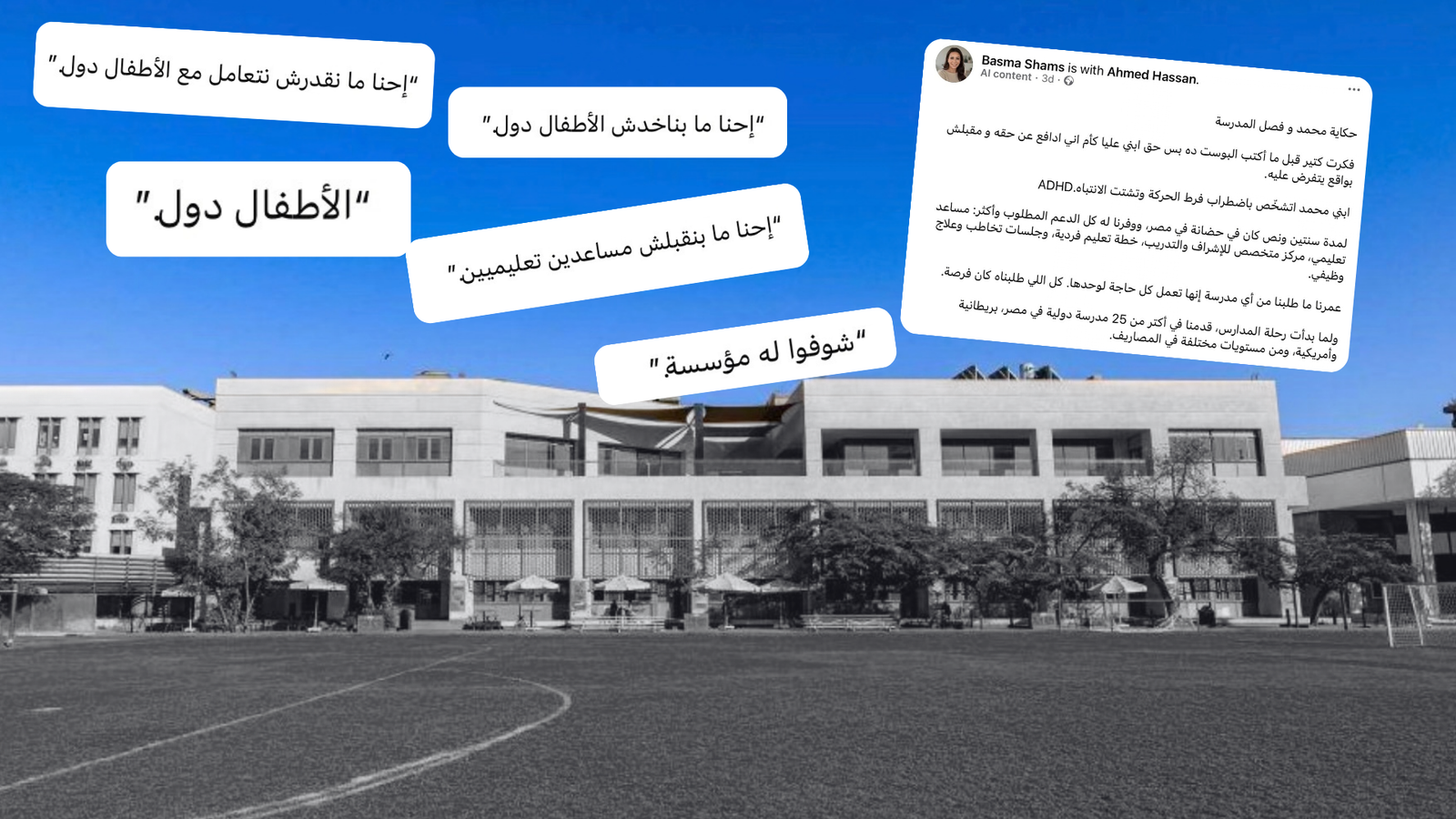
Egypt has policies designed to ensure children who need additional educational support/inclusive education can access mainstream schools. But one mother’s experience trying to find a school for her son raises questions about what happens when those policies reach the admissions office.
Basma Shams, a mother in Cairo, says she applied to more than 25 international schools in Egypt for her son Mohamed, who has ADHD, yet still couldn’t enroll him in any school.
Her request wasn’t for schools to manage his needs alone. Mohamed already had additional support, including an LSA, an individual education plan, speech therapy, occupational therapy, and support from a specialized center. Still, she says school after school rejected him.
What concerned her wasn’t only the rejection, but what she says some schools told the family during the process:
“We don’t accept these kids.”
“We can’t deal with these kids.”
“You should look for an institution.”
Eventually, finding a school became difficult enough that the family moved Mohamed to
The Same Child, a Very Different School Experience
According to his mother, several Dubai schools assessed Mohamed before he was accepted into an academically rigorous British school.
There, he completed FS2 successfully, joined advanced classes in some subjects, participated in sports and other activities, and even performed in his school’s annual production.
The family still had to provide the additional therapies and resources he needed. According to his mother, the difference was that the school was willing to work with them.
Then circumstances brought the family back to Egypt.
Mohamed returned with a school record documenting his progress and his advancement to Year 1. His mother expected to find a school more easily this time. And of course, it wasn’t.
This time, she says, the answer they repeatedly received was: “There is no space.”
Eventually, the family obtained an official ministerial decision allowing Mohamed to be admitted above a school’s normal capacity.
According to his mother, one international school still told the family, verbally and on two separate occasions, that despite the official decision, it was not required to comply because it was an international school.
And that’s where Mohamed’s story raises a much bigger question.
What Are Schools Actually Required to Do?
Egypt already has an educational inclusion framework. Ministerial Resolution No. 252 of 2017 established rules for including students with mild disabilities in mainstream education, including in private schools and schools teaching special curricula.
The Ministry of Education has also explicitly addressed ADHD within its educational inclusion materials. More recently, in 2024, the Ministry issued Circular No. 9 concerning admissions to private and international schools.
The circular provides for an additional 5% above the prescribed capacity of private and international schools for eligible students with mild disabilities.
More importantly, the Ministry explained why the measure was necessary: authorities had observed reluctance among some private schools to accept students with disabilities.
So the problem isn’t necessarily the absence of an inclusion policy.
The question is what happens when individual schools are asked to implement it.
“We’re Full” Isn’t Necessarily the End of the Conversation
The additional 5% matters because capacity was one of the main obstacles Mohamed’s family says it encountered after returning to Egypt.
The rule doesn’t mean that every child with ADHD must automatically be admitted to any school their parents choose. Assessments, eligibility requirements, and procedures govern educational inclusion.
But for children who qualify, an established mechanism is designed to create places beyond a school’s normal capacity.
That makes it important for parents to know not only that an inclusion policy exists, but what it actually entitles their children to and what they can do when a school refuses admission.
It also raises questions about enforcement.
If a child has completed the required procedures but a school still refuses admission, who reviews that decision?
What reasons can a private or international school legally give for refusing?
And what happens if a school simply doesn’t follow the rules?
Mohamed Eventually Got His Seat in a Classroom
After another long search, Mohamed was eventually accepted into El Alsson School in Sheikh Zayed. His mother says no connections, special calls, or favors were involved. The school assessed him and gave him a place.
With that said, this school is still not the best option for Mohamed or his family. The family lives in East Cairo, meaning Mohamed now faces at least two hours of commuting to school every day. His mother says they may eventually have to move homes again.
But after everything the family went through, distance is a problem they can solve. Access was the harder one.
And Mohamed’s experience shouldn’t automatically be treated as representative of every child requiring educational support in Egypt. It is one family’s account.
But that’s exactly why the next question matters.
How many other families have had the same experience?
If you’ve tried enrolling a child who needs additional educational support in a school in Egypt, El-Shai wants to hear about your experience.
Egypt already has rules governing inclusive education. Now the question is whether every school is following them.


