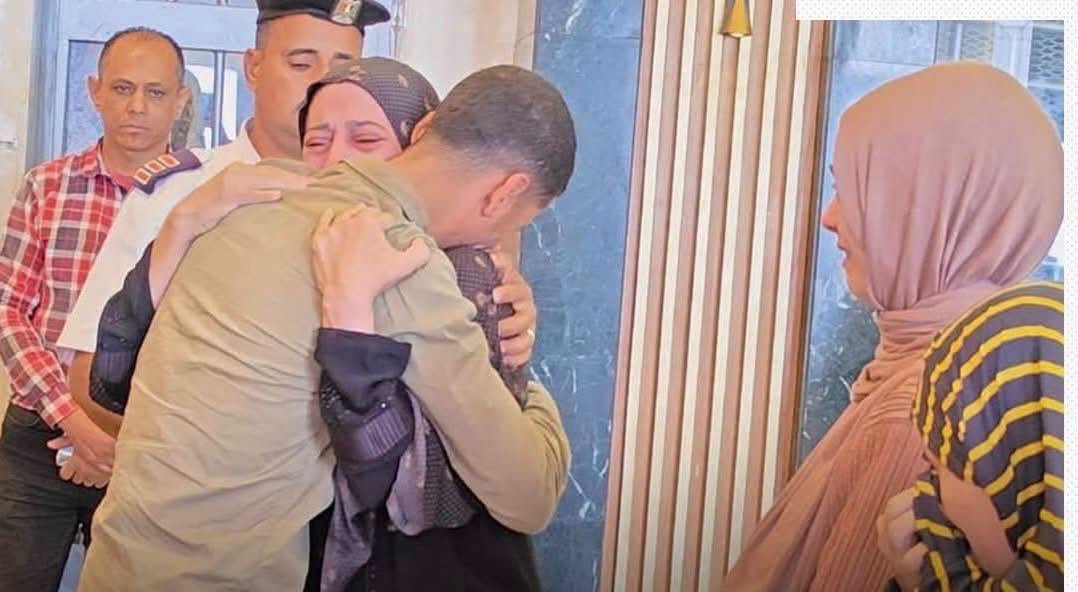
Two children are dead. Their grandmother, aunt and another relative are on trial for allegedly murdering them. Prosecutors have presented reported confessions, forensic findings, and witness testimony. Yet, in a Giza courtroom, the children’s father embraced his mother, defended her innocence, and formally reconciled with the women accused of killing his children.
On November 2, 2026, a courtroom scene in Giza drew attention for what appeared to be a deeply emotional family reunion. A father embraced his mother, insisting she could never have harmed his children.
But this was no ordinary family dispute. The woman he embraced, identified as Wafaa M., is the principal defendant in the alleged murders of his two children, Rahma and Rahim, in El-Saff, Giza.
Alongside her sister, Fatma M., and her daughter, Manar M., Wafaa faces charges of premeditated murder. Prosecutors allege that the three women deliberately killed the children with chlorine injections motivated by hostility toward the children’s mother.
The father has now reconciled with all three defendants. Reports indicate that both parents signed a reconciliation agreement, despite the serious evidence outlined in the prosecution’s case.
The development raises a question that extends beyond the courtroom: When a father chooses to defend relatives accused of murdering his children, who is advocating for the children themselves?
What Happened to Rahma and Rahim?
According to the prosecution’s case, the alleged killings took place in El-Saff, Giza, during March and April 2026.
Rahma was allegedly attacked first. Investigators say the defendants prepared a syringe containing chlorine and that the grandmother administered the injection while the other women restrained the child.
Rahma suffered severe internal injuries and underwent medical treatment, including surgery, before eventually dying.
Her younger brother, Rahim, was allegedly targeted after his birth. According to the prosecution, the women had already decided to kill him while his mother was still pregnant.
The prosecution alleges that the grandmother again administered the injection while the other defendants assisted or monitored the surroundings. Rahim died in April, reportedly around one month after his birth.
The children’s mother initially received explanations suggesting their injuries had resulted from snakebites. However, medical examinations and subsequent investigations raised suspicions about those accounts.
Investigators eventually identified the grandmother and two other relatives as suspects.
The alleged motive was particularly disturbing. According to the prosecution, the women wanted to punish the children’s mother because of ongoing family disputes. Investigators alleged that the children were targeted because they represented a bond between their parents, and that eliminating them might lead to the couple’s separation.
These allegations form part of the prosecution’s case and have not yet been established by a final court judgment.
The Reported Confessions and Evidence Against the Defendants
The prosecution’s case involves more than accusations arising from a family dispute.
According to evidence documents obtained and published by Al-Masry Al-Youm, the first and second defendants gave detailed statements during questioning on April 27, 2026, acknowledging their alleged involvement in the killings.
Prosecutors also recorded videos in which the two women reportedly described how the crimes were planned and carried out, including their alleged motives and the involvement of the third defendant.
The evidence outlined in the published investigation records also includes witness testimony, medical examinations, forensic findings, and syringes reportedly recovered during the investigation.
One particularly troubling allegation concerns the second defendant, who reportedly expressed a desire during questioning on May 25 to kill the children’s mother in retaliation for reporting the crimes. According to the prosecution’s notes, that threat was also recorded.
However, the defendants subsequently denied the charges in court. The earlier statements, their circumstances, and the forensic findings remain subject to judicial examination.
A reported confession is significant evidence, but it is not a substitute for a court determining guilt after considering the entire case and the defense’s arguments.
A Father Who Insists His Mother Could Never Have Done It
Despite the allegations and reported evidence, the children’s father publicly defended his mother during the November 2 hearing.
According to Masrawy, he told the court:
“دايما بسمع كلام أمي وعمرها ما هتعمل كده في عيالي”
He also reportedly explained that his mother had encouraged him to marry young because she wanted to enjoy having grandchildren.
His statements suggest that his defense rests, at least publicly, on his relationship with his mother and his belief that she would never intentionally harm his children.
He reportedly maintained that he wanted whoever was actually responsible for the deaths to face justice.
Yet the contradiction remains difficult to ignore.
The prosecution has presented a case involving alleged confessions, forensic evidence, and witness testimony. The father, meanwhile, is publicly defending the principal defendant on the basis of his personal belief in her innocence.
That does not mean his belief is necessarily dishonest. He may genuinely believe his mother has been wrongly accused.
But the public reporting does not establish how he reconciles that belief with the evidence presented by prosecutors, whether he disputes the reported confessions, or whether he has offered an alternative explanation for his children’s deaths.
Those are important unanswered questions.
The Reconciliation: What Is the Father Actually Trying to Achieve?
During the November 2 hearing, lawyers submitted a formal reconciliation agreement involving the children’s parents and the three defendants.
According to court coverage, the agreement included an attempt to withdraw criminal and civil claims from the family’s side, alongside a change in the position taken toward the third defendant.
The father also embraced his mother inside the courtroom after the judge permitted the interaction.
However, reconciliation does not automatically mean the accused will be released or that the murder charges will disappear.
Under the Egyptian criminal procedure rules currently in force, premeditated murder is not among the offenses that can be terminated simply because the victim’s family agrees to reconcile.
The distinction is important.
A family can withdraw certain civil compensation claims, but a criminal prosecution for murder is not exclusively controlled by the victim’s relatives. The state retains responsibility for prosecuting serious crimes and establishing criminal accountability.
There is also an unresolved procedural detail. While reports describe the submission of a reconciliation agreement, coverage of the same hearing refers to a lawyer representing the children’s heirs requesting EGP 100,001 in provisional civil compensation and supporting the prosecution’s demand for the maximum penalty.
Without the complete court record, the precise relationship between these positions remains unclear.
The court has not announced an acquittal or a release resulting from the reconciliation.
But Who Is Thinking About Rahma and Rahim?
The courtroom reunion has attracted attention because of the relationship between the father and his mother. But that relationship is not the only one that matters.
There were two other people at the center of this case: Rahma and Rahim.
They were children who depended on adults for their safety, care, and protection. They had no control over the family disputes surrounding them, no ability to defend themselves against the alleged violence, and no opportunity to participate in the decisions now being made in court.
Their father has the right to believe his mother is innocent. He also has the right to decide how he wishes to maintain his personal relationships.
But his belief in his mother’s innocence cannot replace the court’s examination of the evidence, and his decision to reconcile cannot determine whether a criminal offense occurred.
There is a difference between forgiving someone for a personal wrong and seeking reconciliation in a case involving the deaths of two other people.
That distinction becomes especially important when those people are children.
Rahma and Rahim cannot explain what happened to them. They cannot challenge the defendants’ accounts, dispute their father’s position, or express their own wishes about the case.
Their interests must therefore be represented through the legal process, the evidence, and the institutions responsible for investigating and prosecuting their deaths.
The question is not whether a grieving father should be denied the right to forgive or to believe in his mother’s innocence. It is whether the pursuit of justice for his children should depend on that belief.
It should not.
Family Loyalty Cannot Replace Evidence
The father’s decision also raises a broader question about the role of family loyalty in cases involving alleged violence within families.
His courtroom statements emphasized his mother’s history of caring for him and her apparent affection for her grandchildren.
Those memories may explain why he finds the allegations difficult to accept.
But a person’s previous behavior, however loving or supportive, does not establish whether they committed a particular crime.
Equally, a criminal accusation, even one supported by reported confessions, cannot be treated as a conviction before the evidence has been examined by the court.
The purpose of the trial is to establish what happened, determine whether the defendants are responsible, and reach a judgment based on the law and the evidence.
That responsibility cannot be transferred to a father’s personal convictions about his mother.
Nor should public outrage substitute for the judicial process.
What Happens Next?
The Giza Criminal Court has postponed the trial until December 9, 2026, for further proceedings and arguments.
The defense has requested the examination of forensic doctors involved in the case, making the medical evidence an important part of the continuing trial.
The court must still assess the reported confessions, forensic findings, witness testimony, and the defendants’ denials before reaching a verdict.
For now, three women remain accused of murdering Rahma and Rahim, and their legal responsibility has not been determined by a final judgment.
The father’s reconciliation has added another complicated dimension to an already devastating case.
But whatever the reasons behind his decision, the fundamental question remains unchanged.
A father can choose to forgive. He can choose to defend his mother. He can even believe that the prosecution has accused the wrong people. But Rahma and Rahim’s deaths still demand answers, independently of the relationships and loyalties of the adults who survived them.
The courtroom may have witnessed a reunion between a mother and her son.
It must not lose sight of the two children who will never return home.