
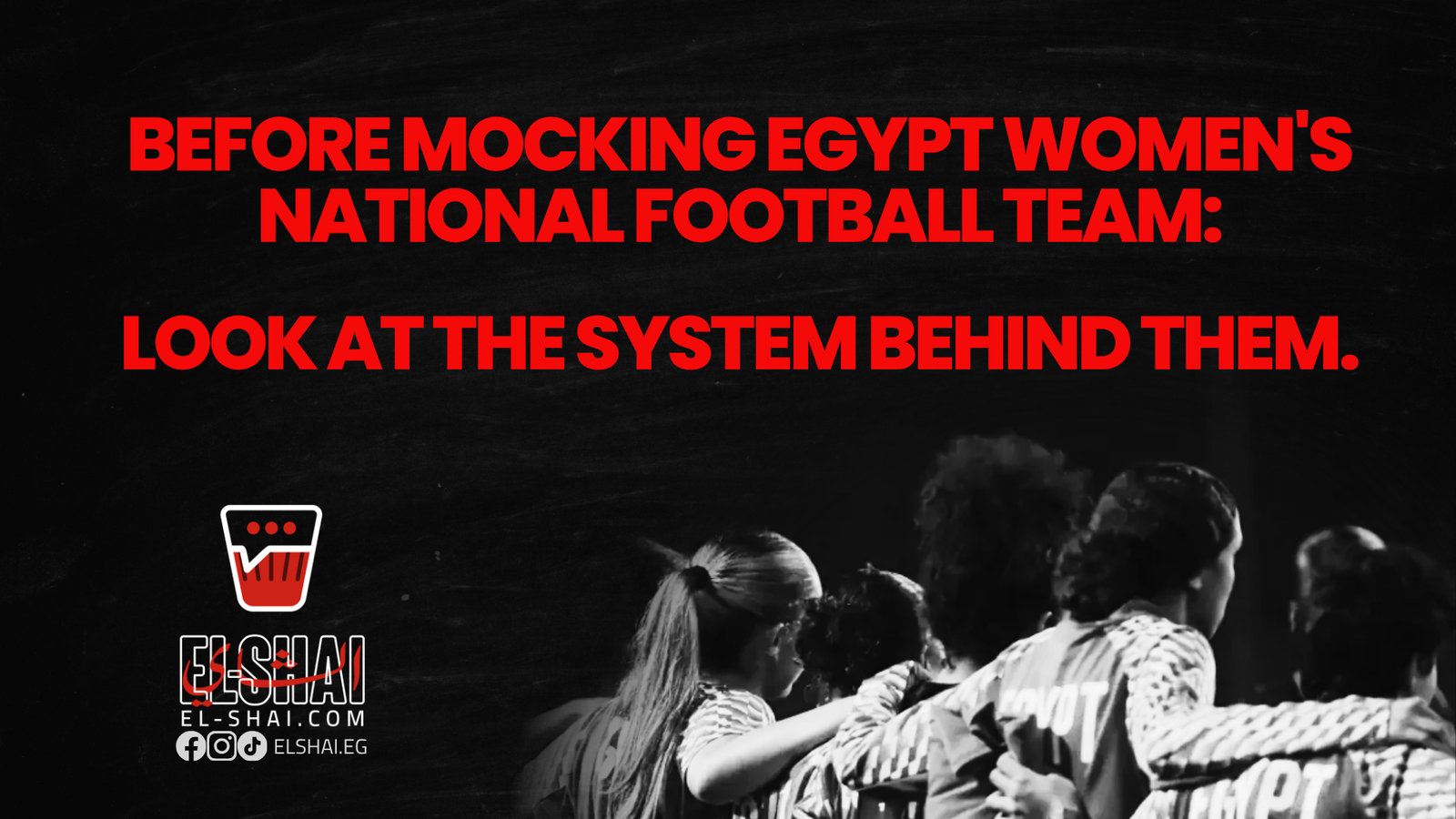
Egypt’s Women’s National Football Team’s 6–0 WAFCON defeat to Zambia deserves serious criticism. The sexist ridicule surrounding it ignores the professional, financial, and developmental gap the players were expected to carry onto the pitch.
Six nil is a terrible scoreline. There is no honest way around that.
Zambia comprehensively beat Egypt in their opening match of the 2026 Women’s Africa Cup of Nations. They conceded two penalties, struggled to deal with crosses and movement inside the penalty area, and completely lost their defensive organization toward the end of the match.
According to CAF’s official match report, Zambia captain Barbra Banda scored four goals and assisted another. Egypt went into halftime only 1–0 down, but the game unraveled after Zambia’s second penalty in the 58th minute. Three of the six goals arrived from the 86th minute onward.
It was not a good performance, and pretending otherwise would be patronizing to the players.
But much of the reaction quickly stopped being about football.
It stopped being about the penalties, the defensive setup, the physical collapse or whether the coaching staff had a plan for one of Africa’s most dangerous forwards. Instead, the result became an opportunity to mock women’s football itself, ridicule the players and suggest that the score somehow proved women had no place on the pitch.
That is not football analysis.
Criticizing the performance is fair. Treating the players as a punchline because they are women is not.
At the same time, some of the people attempting to defend the team went in the opposite direction, circulating the claim that Egypt had won the previous Women’s World Cup.
That is also untrue.
Both reactions avoid the reality of the team in different ways. One reduces the players to a humiliating scoreline. The other invents achievements to turn them into an inspirational story.
Neither treats them seriously as footballers.
Egypt Did Not Win the Women’s World Cup or Initially Qualify for WAFCON
Despite claims circulating online, Egypt did not win the previous senior FIFA Women’s World Cup. Spain won the 2023 tournament, while Egypt did not participate.
The confusion may come from Egypt’s Special Olympics Unified Women’s Football team, which won silver in Division 2 at the 2026 Unified Football World Cup in Paris. That was a genuine achievement by a different team in a different competition, not a senior FIFA World Cup title.
Egypt’s senior women’s team also did not initially qualify for WAFCON 2026. They lost to Ghana before CAF expanded the tournament from 12 to 16 teams and added Egypt as one of the four highest-ranked sides eliminated in the final qualifying round.
None of this means Egypt had no right to participate after the expansion. It explains the team’s developmental position before facing a Zambia side with recent World Cup and Olympic experience.
Defending Egypt’s women does not require inventing trophies or pretending that losing 6–0 was acceptable.
The truth is already strong enough.
Egypt and Zambia Did Not Arrive From the Same Football World
On paper, this was a match between two national teams competing in the same tournament.
In reality, they arrived from two very different football worlds.
CAF described Zambia before the match as an established international side accustomed to competing at the top of African football and on the world stage. Zambia played at the 2023 FIFA Women’s World Cup and the last two Olympic Games. The team also finished third at WAFCON 2022.
Ahead of the 2026 tournament, Zambia prepared through international matches against South Korea, Brazil and Canada. Their attack is led by players including Banda and Racheal Kundananji, who are accustomed to professional football and elite international opposition. CAF described Zambia as a genuine contender for its first continental title.
Egypt, meanwhile, were returning to WAFCON after ten years away.
Their defenders do not regularly face forwards of Banda’s quality, movement, strength and finishing in Egypt’s domestic league. A short national-team camp cannot recreate the experience Zambia’s players have gained through World Cups, Olympic Games, continental tournaments and professional club football.
The gap was not created during the 90 minutes.
The match revealed it.
A National Team Cannot Develop Beyond the System Producing It.
A national team is not built during a short pre-tournament camp.
It is the end product of what players experience every week at their clubs. It reflects the quality of youth development, coaching, physical preparation, medical care, tactical education, nutrition, recovery and competitive opportunities available from the time players first enter the sport.
That is where the public reaction becomes dishonest.
People are demanding the results of a mature professional football system from a women’s game that has only recently begun creating one.
Al Ahly and Zamalek, the two largest football institutions in Egypt, only made their Egyptian Women’s Premier League debuts during the 2024–25 season.
In a 2024 report on Egyptian women’s football, The National noted that CAF had been pressuring major African clubs to create women’s teams as part of its continental club licensing requirements. Al Ahly and Zamalek eventually entered the league within that wider push.
That context matters.
The men’s teams of Al Ahly and Zamalek have more than a century of history behind them. They benefit from generations of supporters, academies, scouting systems, sponsorships, facilities, medical departments and institutional experience.
Their current women’s league projects are only a few seasons old.
The badge may be the same. The football environment behind it is not.
A national team cannot instantly become internationally competitive because major clubs have finally started establishing women’s sides. Building players requires years of consistent development, not simply adding teams to a league table.
What Happens When Women Are Given Professional Conditions?
FC Masar, formerly known as Tutankhamun FC, provides one of the clearest examples of how much the players’ environment matters.
In its 2024 report, The National spoke to FC Masar coach Ahmed Ramadan about the condition of the team before its transformation. Ramadan said the players had come from a system in which they trained and played only twice a week.
Under the new project, training increased to five days a week, proper gym work was introduced, and the staff focused on improving the players’ fundamentals, technique, physical development, mentality and ability to perform for 90 minutes.
The report also stated that every Masar player received a professional contract. The club paid them enough to leave their day jobs and dedicate themselves to football, while players still attending university received support to manage scheduling conflicts.
Crucially, The National described those professional contracts as a rarity in Egyptian women’s football at the time.
Masar went on to become a domestic champion and reached the CAF Women’s Champions League semifinals.
The players did not suddenly acquire talent when the project changed.
Their environment changed.
They trained more frequently. They received physical preparation, organizational support and contracts that allowed football to become their primary responsibility. The standard of the team rose with the standard of the conditions around it.
That should tell us more about Egyptian women’s football than any joke about the Zambia scoreline.
Can Football Actually Be Their Full-Time Profession?
There is no transparent public database showing the salaries of every player in the Egyptian Women’s Premier League.
We also do not know how many members of the current national-team squad have other jobs, how many depend entirely on football or how many combine the sport with university.
It would therefore be irresponsible to claim that every player in the squad works elsewhere.
What the available reporting does show is that earning a genuine professional living from women’s football has historically been far from guaranteed.
In March 2022, Kora Plus reported that the highest-paid player in the Egyptian women’s league earned EGP 4,000 per month. The next three salaries listed were EGP 3,500, EGP 3,000 and EGP 2,500.
Those figures are several years old. They should not be presented as the current league average, particularly after the arrival of Al Ahly and Zamalek and the continued development of FC Masar.
However, a more recent example suggests that the problem did not disappear immediately.
In April 2025, Kora Plus reported that Al Ahly player Roudina Abdel Rasoul was earning EGP 5,000 per month before the club recommended adjusting her contract. The report described her as one of the team’s prominent players and noted her involvement with the national-team setup.
Her revised salary was not publicly disclosed, and one player’s contract cannot be presented as the league average.
But these examples reveal the conditions from which the women’s game has been attempting to grow.
International football requires daily training, proper nutrition, sleep, recovery, medical treatment, video analysis and the ability to organize an athlete’s entire life around performance.
Talent and determination matter. They cannot replace time, resources and professional support.
The public cannot demand professional international results without asking whether football has genuinely been allowed to become a profession for the women expected to produce them.
Egypt Already Understands This When the Player Is a Man
The reaction to Mostafa Ziko’s rise offers an important contrast.
After his success with the men’s national team, Ziko spoke publicly about the difficult conditions he experienced before football provided him with financial stability.
In an interview reported by Shorouk, Ziko said he would attend training with Gomhoreyet Shebin at eight in the morning and then return to help sell clothes at his family’s street stall until ten at night, without having time to rest between the two.
His story was received as an example of extraordinary perseverance.
That response was correct.
Nobody used the fact that Ziko had to work alongside football as proof that he was unserious, untalented or unworthy of representing Egypt. His difficult circumstances made the country admire what he had overcome.
Yet when women emerge from a football system where full professional contracts have been described as rare, the conditions disappear from the conversation.
When a man succeeds despite inadequate support, the public celebrates his resilience.
When women struggle under inadequate support, many people treat the result as proof that they should never have been playing.
The comparison does not mean that Ziko and every member of the women’s team have identical personal circumstances. We do not know the employment situation of every player in Egypt’s WAFCON squad.
The comparison is about the public’s ability to understand context.
Egyptians already recognize that a player’s development is affected by financial hardship, limited resources and the need to divide time between football and earning a living.
That understanding should not disappear because the players are women.
Defending the Players Does Not Mean Protecting Them From Criticism
There are legitimate questions that should be asked about the Zambia match.
Why did Egypt concede two penalties?
Why was the team repeatedly unable to deal with deliveries into the penalty area?
Why was Banda allowed so much space?
Why did the defensive structure collapse so badly after the second goal?
Why did three goals arrive in the closing minutes?
Were the substitutions effective?
Was the team physically prepared to maintain its organization against Zambia for the full match?
Those are football questions. The coaching staff and players should have to answer them.
Women footballers should not be infantilized or treated as though any criticism is sexist. They represent Egypt at the highest continental level, and their performances should be discussed seriously.
But serious criticism is not the same as humiliation.
A discussion about defensive positioning is football criticism.
A discussion about preparation, coaching, conditioning and the development of the domestic league is football criticism.
Using the result to mock women, their bodies, their abilities or their right to play is not criticism. It is prejudice borrowing a scoreline.
The Players Did Not Make the Decisions That Brought Them Here
The players did not decide how long Egypt would go without appearing at WAFCON.
They did not decide when Al Ahly and Zamalek would finally form women’s league teams.
They did not determine how many girls’ academies would exist, how many youth competitions would be organized or how many strong international matches Egypt would play.
They did not set club salaries.
They did not decide whether women’s football would be televised, promoted or treated as a viable career.
They did not build the system.
They are simply the people required to represent it in public.
When the system succeeds, administrators, clubs and institutions will all claim a share of the achievement.
When it fails, the players should not be left standing alone beneath the scoreboard.
Six Goals Do Not Prove Women Cannot Play Football.
The 6–0 defeat exposed a major gap between Egypt and Zambia.
It was a gap in international experience, domestic professionalization, player development and exposure to elite competition.
It was also evidence of poor defending and a damaging late collapse.
All of those things can be true at once.
Egypt’s players should learn from the performance. The coaching staff should be questioned. The federation and clubs should be expected to explain how they intend to close the gap.
But the public should also be honest about what it is demanding.
You cannot neglect women’s football, ignore its league, barely support its players and then suddenly become an expert when there is an embarrassing scoreline.
You cannot demand professional international results without asking whether the women representing the country have been given professional domestic lives.
And you cannot spend years treating the women’s game as an afterthought, then blame the players when the rest of Africa does not wait for Egypt to catch up.
Egypt’s women do not need us to pretend they won a World Cup.
They do not need to be protected from legitimate criticism.
They need their actual achievements recognized, their failures analyzed honestly, and the system behind them examined with the same seriousness applied to the men’s game.
The players lost the match.
They did not build the system that failed them.


