
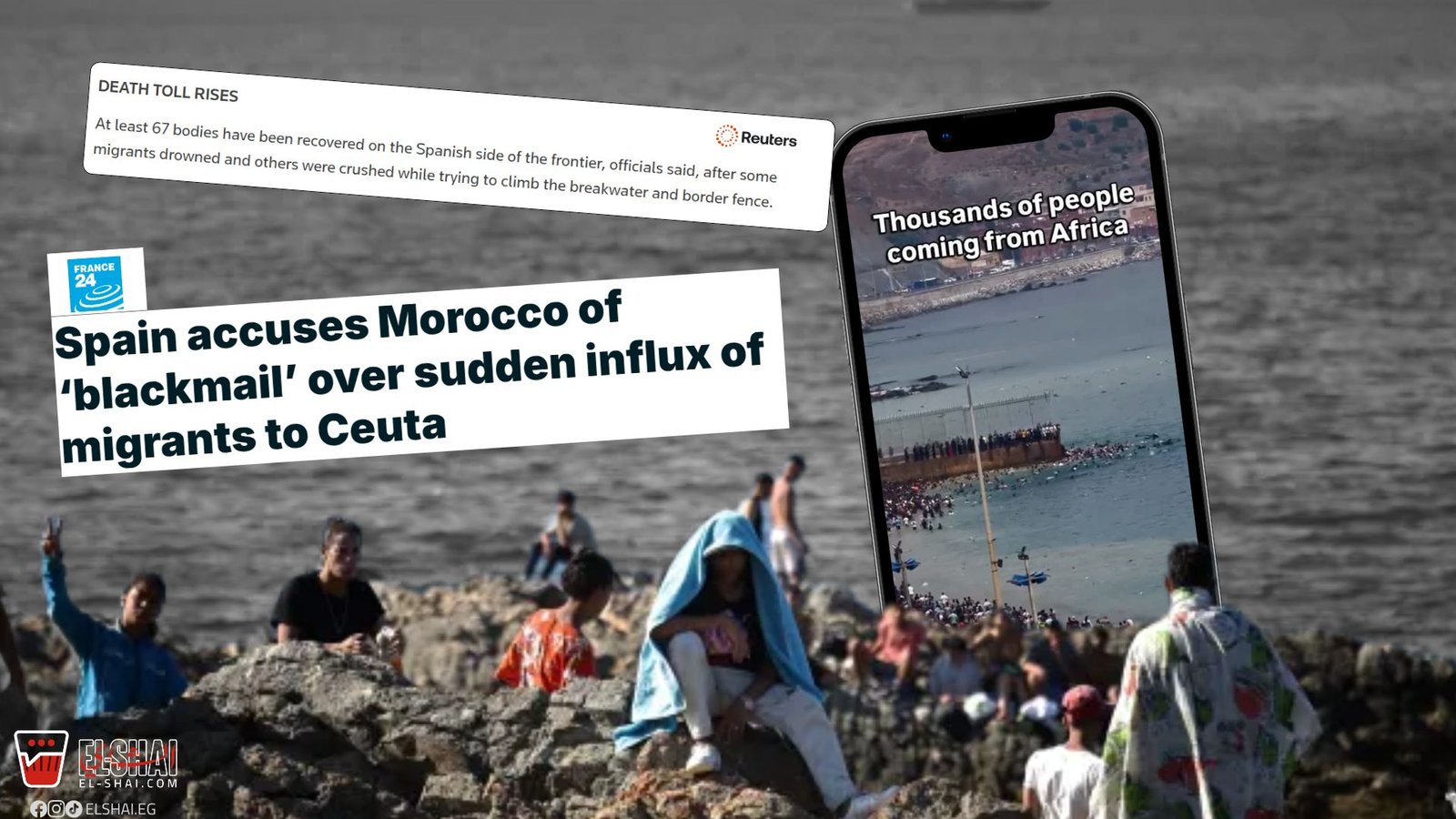
Up to 60,000 people entered the Spanish-controlled city of Ceuta from Morocco within two days. A false promise may have triggered the movement, but the crisis began long before anyone entered the water.
It began online. Posts, groups, and videos started circulating in Morocco, telling people that there was a new opportunity to enter Ceuta, a Spanish-controlled city on the North African coast. The central claim was that anyone who reached Ceuta by swimming could not be deported.
That was false.
But the claim spread quickly. People began traveling toward the border from different parts of Morocco. Then, videos appeared showing the first groups successfully reaching Ceuta by sea and passing overwhelmed security forces.
Those videos changed everything.
What had initially sounded like an online rumor now appeared to have proof behind it. People could see others reaching Spanish territory. They could see that the border was struggling to contain the growing numbers. Many believed the opportunity would disappear as soon as Spain regained control.
More people traveled north. More people crossed. Their videos encouraged still more people to follow.
Reuters interviewed a 16-year-old who was still approximately 12 hours away from the border when he saw videos of people crossing on Instagram and decided to travel north with his cousin. The movement did not only involve residents of the Moroccan border town of Fnideq. People arrived from different parts of the country by bus, taxi, motorcycle, hitchhiking, and on foot.
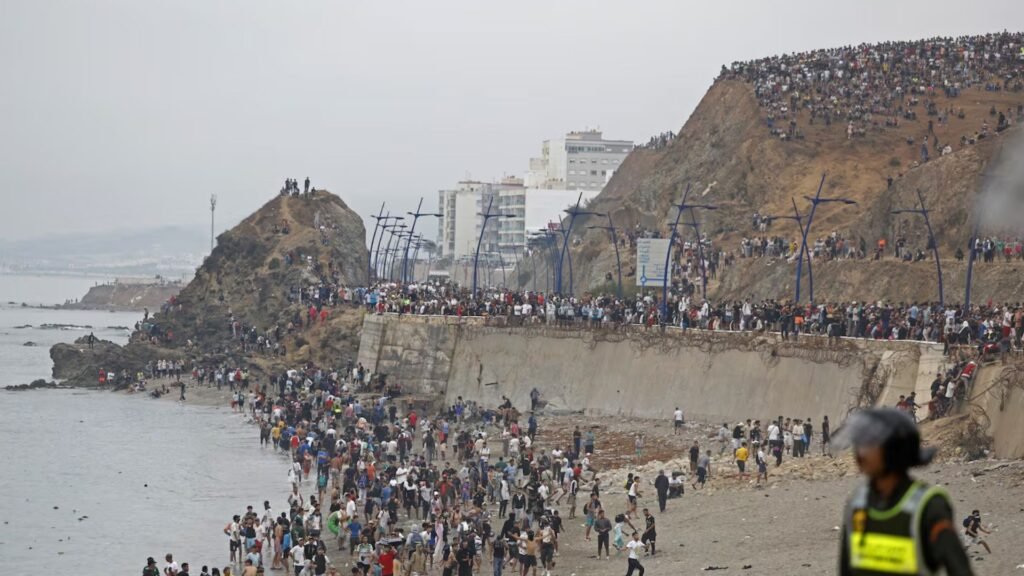
Within approximately two days, Spanish authorities estimated that more than 50,000 people had entered Ceuta, while the city’s regional government placed the number as high as 60,000.
Those figures remain emergency estimates rather than an exact registration of every person who crossed.
The human cost was devastating. By August 1, Spanish authorities said at least 67 people had died, including people who drowned and others who were crushed while attempting to cross the breakwater and border fence.
This does not mean that one organizer secretly controlled 60,000 people.
It means that an online message created a shared signal, early crossings appeared to confirm it, and the movement grew faster than either Morocco or Spain stopped it.
Who originally created or coordinated the online mobilization remains unclear. Spain has accused smuggling and trafficking networks of exploiting the court decision, but there is not yet a complete public investigation identifying the first accounts behind the campaign or proving that one central organization directed the entire movement.
But to understand why one false claim could persuade so many people to risk drowning, we first need to understand what Ceuta is, why Spain controls a city on the Moroccan coast, and why crossing a short stretch of water can mean passing from Africa into the European Union.
But First, What Is Ceuta?
Ceuta is located on the North African coast. It shares a land border with Morocco, but it is controlled by Spain and considered Spanish and European Union territory.
Together with Melilla, another Spanish-controlled city surrounded by Morocco, it forms one of the European Union’s only direct land borders with Africa.
Spain describes Ceuta as an autonomous Spanish city. Morocco does not recognize Spanish sovereignty over Ceuta and Melilla and often describes them as occupied territories.
Portugal captured Ceuta in 1415 during its early imperial expansion into Africa. The city later came under Spanish control and remained Spanish after Portugal regained its independence. Spain argues that Ceuta has belonged to the country for centuries and was never part of the modern Moroccan state.
But that legal argument does not remove the colonial reality.
A European power conquered a city on the African mainland during its imperial expansion, and a European country continues to control it today.
On one side of the fortified border is Morocco. On the other is Spanish territory and, therefore, a potential entrance into the European Union.
That geography is exactly why the online rumor became so powerful.
What Did the Spanish Court Actually Say?
The false online claim was based on a real Spanish Supreme Court decision issued in July.
The court ruled that Spain could not use a special procedure known as a summary border rejection, or “hot return,” against migrants intercepted while swimming toward Ceuta or Melilla.
Spanish law allows authorities to immediately reject some people caught attempting to cross the physical border barriers surrounding the two cities. The Supreme Court found that this exceptional procedure referred specifically to people crossing those barriers and could not automatically be extended to people intercepted at sea.
This did not mean that swimmers could never be deported.
It meant Spanish authorities had to identify them and process their cases through the normal immigration system. Officials would need to determine whether someone was a minor, an asylum seeker, a trafficking victim, or otherwise entitled to legal protection.
After that process, Spain could still return people who did not have the right to remain.
The ruling did not grant residency.
It did not guarantee asylum.
It did not allow people to travel freely to mainland Spain or the rest of Europe.
Online, however, this complicated legal distinction became:
Spain can no longer deport anyone who reaches Ceuta by sea.
That version was easier to understand, easier to share, and much more powerful.
Spanish authorities say people-smuggling networks deliberately promoted the false interpretation. Reuters also found that people who attempted the crossing had seen posts and videos describing the judgment as a new opportunity to enter Spain.
So Who Allowed This to Happen, and Who Benefited?
The incident arrived on a silver platter for Spain’s far right and anti-migration movements across Europe.
Images of tens of thousands of people entering Spanish territory were quickly used to support claims that Europe was being “invaded,” that the Spanish government had opened the border, and that stronger immigration restrictions were needed.
Some people have gone further and suggested that right-wing groups deliberately created the crisis.
There is currently no hard evidence proving that Spanish or European political movements organized the online campaign or instructed people to cross.
The Associated Press also found no evidence supporting theories that the movement had been secretly organized by foreign right-wing governments or in retaliation for Spain’s positions on Gaza, Iran, or other international issues. Political groups clearly benefited from the incident, but benefit is not proof of prior involvement.
But there were several warnings that a major surge was coming, and Spanish authorities failed to respond adequately.
The Supreme Court had not opened the border. It had required Spain to follow normal legal procedures before returning people intercepted at sea.
That distinction matters. Immediate returns can prevent authorities from determining whether someone is a minor, an asylum seeker, a trafficking victim, or at risk of persecution. Due process is not the same as allowing everyone to stay.
But the risk of the ruling being deliberately or accidentally misrepresented was extremely predictable.
Ceuta is directly beside Morocco. Some swimming routes remain extremely dangerous, but near the coastal barriers, the distance can appear short and possible, particularly during calm summer conditions.
Once posts began circulating claiming that swimmers could not be deported, Spain should have expected more people to attempt the crossing.
The warning signs were already visible. Approximately 1,500 people had entered Ceuta by swimming during the previous week. Reception facilities were overwhelmed, hundreds of people were reportedly sleeping outside, and centers for unaccompanied minors were operating at 2,400% of their intended capacity.
Spain could have launched a clear information campaign in Arabic and Moroccan Darija explaining what the court had actually ruled. It could have increased sea patrols, prepared additional processing facilities, and worked with Moroccan authorities to challenge the false information before it reached more people.
Instead, the misinformation continued spreading alongside videos showing that people were successfully entering Ceuta.
The court did not invite tens of thousands of people into Spain. But the Spanish government failed to address the public interpretation of the ruling or adequately prepare for a surge it had clear reasons to expect.
Morocco’s actions raise a separate set of questions.
Moroccan security forces eventually used water cannons, tear gas, batons, and other measures to stop people approaching the border. However, journalists and witnesses also described officers initially doing little while large crowds moved toward Ceuta.
The Associated Press reported that Moroccan guards appeared passive during the early stages before security forces later intervened. That change in behavior raises several possibilities: authorities may have underestimated the movement, lost control of the crowds, or deliberately allowed pressure to build before stopping it.
There is also an important precedent.
In May 2021, around 8,000 people entered Ceuta after Morocco relaxed border enforcement during a diplomatic dispute with Spain. The crisis followed Spain’s decision to allow Brahim Ghali, the leader of the Polisario Front and Western Sahara’s independence movement, to receive medical treatment in the country.
Morocco strongly objected, and Spain publicly accused Morocco of using its passivity at the border as political “blackmail.”
Relations later improved after Spain changed its long-standing position and supported Morocco’s autonomy proposal for Western Sahara.
That history makes it reasonable to ask whether migration was again being used as political pressure.
The latest crossings came amid renewed Spanish contact with Algeria, Morocco’s regional rival and a supporter of the Polisario Front. Reuters also reported speculation surrounding Spanish measures related to Sahrawis and the fact that the crossings coincided with Morocco’s Throne Day holiday.
But suspicion is not proof.
There is currently no conclusive public evidence that Morocco’s government ordered people to cross, created the online campaign, or deliberately coordinated the movement. Spain’s interior minister has continued to describe Morocco as a reliable partner.
The most accurate conclusion is that Morocco either failed to prevent the crowds from gathering or initially tolerated their movement. Whether that was a deliberate state decision remains unproven.
What can be said with greater confidence is that both governments had warning signs, both depend on one another to manage this border, and both failed to prevent the situation from becoming a humanitarian disaster.
The European right may not have created the crisis. But it immediately benefited from failures that Spain and Morocco had several opportunities to address.
Why Were So Many People Ready to Cross?
A false rumor explains why thousands of people moved at that particular moment. It does not explain why so many were already prepared to risk drowning.
Many of the people interviewed after the crossing described unemployment, low wages, poor public services, and the belief that they had no realistic future in Morocco.
They did not all share the same circumstances, but many were young and looking for work, education, independence, or enough money to support their families.
Morocco has made significant investments in infrastructure, tourism, manufacturing, and social programs. But those developments have not created enough secure opportunities for the country’s young population.
According to a 2026 World Bank report, youth unemployment in Morocco reached approximately 37% in 2024. Another World Bank assessment placed unemployment among people aged 15 to 24 at 36.7% nationally and 48.4% in urban areas.
This does not mean everyone who crossed was unemployed or living in extreme poverty.
Migration is rarely caused by one factor. Some may have had jobs but believed they could earn more in Europe. Others wanted better education, greater personal freedom, security, or the possibility of helping their families.
The online campaign did not create those ambitions. It convinced people that a door had briefly opened.
When the first successful videos appeared, they seemed to offer a route into Europe that did not require obtaining a difficult visa, paying for a boat journey, or climbing the heavily fortified border fence.
For some, that possibility made the risk of drowning appear worth taking.
But Europe Is Not an Innocent Observer
Europe cannot discuss this desperation as though it developed entirely outside European influence.
The immediate crisis began with online misinformation. The deeper conditions behind it were shaped by centuries of European involvement in North Africa, unequal access to movement, and an economic system that allows European money, goods, and companies to travel far more easily than Moroccan workers.
During the twentieth century, Morocco was divided between French and Spanish colonial control. France controlled most of the country, while Spain controlled territories in the north and south until Moroccan independence in 1956.
According to the Oxford Handbook of the Moroccan Economy, the protectorate transformed Morocco’s economy while placing the country in a subordinate position within a colonial economic system. European powers shaped its access to foreign trade, infrastructure, institutions, and economic priorities around their own interests.
Europe did not create every problem Morocco faces today.
Morocco’s government, political elite, and business system are also responsible for inequality, corruption, regional neglect, poor public services, and the failure to create enough secure employment.
Removing their responsibility would replace one incomplete explanation with another.
But Europe cannot remove itself from the story simply because formal colonial rule ended.
The European Union remains Morocco’s largest trading partner. In 2025, the EU accounted for 33.7% of Morocco’s trade in goods, with total trade reaching €62.2 billion.
European businesses benefit from Morocco’s geographic proximity, factories, agriculture, tourism industry, trade agreements, and position as a manufacturing and investment hub.
Goods are encouraged to cross the Mediterranean.
Money is encouraged to cross.
European companies are encouraged to invest.
But the people working within that economy are not offered the same freedom of movement.
Europe Also Pays Morocco to Keep Migrants Away
Morocco is not only a European trading partner. It has effectively become part of the European Union’s external border system.
The EU funds Moroccan border management, police cooperation, anti-smuggling operations, returns, readmission programs, and campaigns warning people against irregular migration.
An official EU factsheet says the bloc committed €234 million in migration support to Morocco between 2015 and 2021. A further €152 million was allocated in 2022 for programs lasting four years.
The EU describes this as cooperation on border management, migrant protection, anti-trafficking operations, and safer migration.
But it also allows Europe to move part of its border enforcement south.
Moroccan forces stop Moroccans and migrants from other African countries before they reach Spanish or EU territory. Europe provides funding, equipment, and diplomatic support.
When that arrangement works, most Europeans do not see the people being stopped on the other side.
When it fails, Europe presents those same people as an unexpected foreign threat.
This is the contradiction at the center of Ceuta.
Spain controls a city on the African mainland. The European Union benefits from its economic relationship with Morocco and pays Morocco to prevent migrants from reaching European territory.
Then, when Moroccans cross into that European-controlled city, politicians describe them as foreigners invading a continent that had no role in creating the border or the inequalities surrounding it.
So at the End of The Day, Was It Really an “Invasion”?
Not Really. By August 1, Spanish authorities said that most of the more than 50,000 people who had entered Ceuta had already returned to Morocco. Many returned after encountering hunger, overcrowding, hostility, and the realization that entering Ceuta did not allow them to freely travel to mainland Spain.
The Associated Press reported that none of those who crossed had reached mainland Europe.
That does not make the event insignificant.
Tens of thousands entered a city with a regular population of around 85,000. Local services were overwhelmed, residents were frightened, and at least 67 people lost their lives. Spain had legitimate responsibilities to restore order and protect both residents and the people who had crossed.
But “invasion” is a political term designed to present desperate civilians as an attacking army.
The people crossing were not soldiers. They did not arrive with a plan to occupy Spanish territory. Most did not remain in Ceuta, and they did not continue into mainland Europe.
They were people who had been convinced by an online campaign that a temporary route into Europe had opened.
So What Actually Happened in Ceuta?
The available evidence points to several connected events rather than one simple explanation.
An online mobilization promoted the false idea that people could enter Ceuta by sea without being deported. The claim distorted a real Spanish Supreme Court decision.
The first successful crossings produced videos that made the rumor appear true. Those videos encouraged thousands more people to travel toward the border before the opportunity disappeared.
Spain failed to respond adequately despite days of warning signs and rising arrivals.
Moroccan authorities either failed to stop the movement or initially tolerated it, although there is not yet evidence proving that the Moroccan government deliberately organized the crossing.
The movement grew because thousands of people were already prepared to leave. High youth unemployment, low wages, inequality, limited legal migration routes, and the hope of building a better future in Europe made the rumor believable.
Europe may not have created the social media posts. It may not have ordered anyone into the sea.
But Europe helped build the border, the unequal economic relationship, and the migration system surrounding it.
It controls territory on the African mainland. It benefits from trade and production in Morocco. It funds Moroccan authorities to prevent migrants from reaching Europe. Then, when that arrangement fails, European politicians blame the people crossing.
The right wing did not need to manufacture the crisis.
It only needed to begin the story at the moment people crossed the border and ignore everything that made them willing to cross it.


