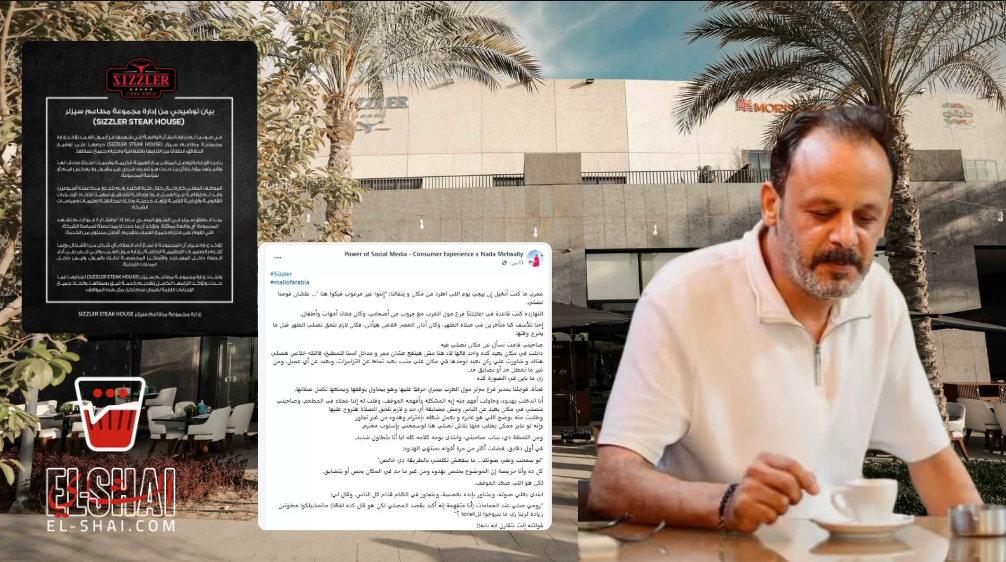
A complaint about prayer inside Sizzler ended with its Mall of Arabia branch manager losing his job. After hearing his account and reading Sizzler’s own statements, the story looks very different from the one that first went viral.
We have been trying to keep our thoughts about the Sizzler controversy to ourselves. Religion is personal, the story was still developing, and at first only one side had spoken publicly.
But after watching former branch manager Waleed El-Agouz explain what happened, and learning that he had actually been fired, we could not stay silent anymore.
We are sorry, but how can anyone frame this as defending Islam while being comfortable with a man losing his job because they were too lazy to walk approximately 50 meters?
Before reaching conclusions, let us take you through what happened.
What Happened Inside Sizzler?
The controversy began when a customer published a Facebook post about an incident at Sizzler’s Mall of Arabia branch. She was dining with a group of friends and children when one of her friends needed to perform Dhuhr prayer.
The original post stated that the group was late with Dhuhr prayers, and Asr was approaching. The woman initially went toward an area that a staff member said was a passage and entrance to the kitchen. She then chose another corner inside the restaurant, which she claimed was not disturbing anyone, yet the management claimed was still a staff area.
The customer alleged that El-Agouz approached her friend while she was praying and attempted to stop her. She said he raised his voice and used expressions including “Go pray by the bathrooms,” “Pray to God, not at my place,” and “You are not welcome here.” She also said he called mall security and that other customers defended the group.
If those allegations were the complete story, the anger would be understandable. Nobody should be humiliated or spoken to disrespectfully because she wants to pray.
However, the original post was later removed before it had been edited more than 11 times, according to several accounts. Although we cannot independently confirm the exact number of edits, we can confirm it was edited. Editing a post does not automatically mean the complaint was false, but the removal and questions surrounding its edits should have made people pause before treating every detail as established fact.
Instead, the incident was presented as if Sizzler had launched a war on Islam, with almost no critical discussion of the most obvious question: Why did the woman insist on praying inside the restaurant when Mall of Arabia already had a designated prayer area nearby?
The backlash became so severe that instead of publicly supporting its employee or explaining what its cameras showed, Sizzler used him as a scapegoat.
Unfortunately, Sizzler Apologized and Fired the Manager
After the post spread and calls to boycott Sizzler grew, the company apologized to the women and described what happened as an unacceptable individual act that did not represent its values.
Sizzler said Waleed El-Agouz had worked there for less than two weeks and was still on probation. It suspended him and referred him for an investigation ahead of terminating his employment. The customer later announced that the owner had personally apologized, that El-Agouz had been permanently dismissed, and that she was satisfied with the measures taken.
How exactly was his dismissal an Islamic victory?
She also said prayer spaces would be provided across the branches and described that as an ongoing charity in her late father’s name. To be accurate, she referred to the prayer spaces as the ongoing charity, not El-Agouz’s dismissal. However, she listed his permanent dismissal among the outcomes she was satisfied to see.
Sizzler’s public apology announced that it would create a prayer space inside its Mall of Arabia branch after coordinating with the mall, even though the mall already had a designated prayer area. The broader claim about spaces in every branch appeared in the customer’s update, not in the official statement we found.
Then Waleed El-Agouz Shared His Account
After losing his job, El-Agouz published a video explaining what he said happened. He said the restaurant’s cameras documented the incident from the group’s arrival until its departure, although that footage has not been released publicly.
According to El-Agouz’s account, staff regularly directed customers to Mall of Arabia’s prayer room, which he estimated was less than 50 meters from Sizzler.
He said another manager first told the women that they could not pray beside the kitchen. When they selected another place inside the restaurant, El-Agouz said he approached them respectfully, explained that prayer could not take place inside the branch, and pointed toward the mall’s prayer room.
According to him, the woman ignored the direction and began praying while he was still speaking. Her friend then told him, “We didn’t come to the mall. We came to Sizzler.”
El-Agouz said the argument escalated after she raised her voice. He argued that he is a 50-year-old man who refused to be spoken to that way in front of the staff he was managing. He said security was only called after the confrontation became disruptive, not because someone had asked to pray.
His account does not prove that he handled every moment perfectly. But it changes the story from “a manager prevented a woman from praying” to “customers refused to use the designated prayer room and insisted on praying inside the restaurant.”
Sizzler Confirmed the Most Important Part of His Story
The strongest support for El-Agouz’s account came from Sizzler itself.
In its clarifying statement, the company said it does not prevent prayer but follows Mall of Arabia’s regulations, which require prayer to take place in the mall’s mosques and designated prayer areas, not inside commercial units.
In other words, Sizzler confirmed that customers were supposed to use the mall’s prayer area, which is exactly what El-Agouz says he told them.
Even if someone personally disagrees with refusing prayer inside the restaurant, El-Agouz was enforcing the mall rule that his own employer later confirmed. Yet he was the person who lost his job.
This does not prove that he never raised his voice or used any of the expressions attributed to him. But it does prove that directing the women away from the restaurant and toward the prayer room was not an attack on Islam.
So what exactly was he fired for?
Sizzler said it referred him for an investigation, but it never published the findings or explained which company policy he violated. Did the cameras confirm that he insulted the customers? Did they confirm his account? Did the investigation even finish before the decision to terminate him was made?
From what has been made public, his dismissal looks less like justice and more like a company sacrificing a probationary employee to stop a social media crisis.
Being Directed to a Prayer Room Is Not Religious Persecution
The women were not told that prayer was forbidden. They were told that it could not take place inside the restaurant and that a designated place was available inside the same mall. The woman ultimately completed her prayer inside Sizzler despite the staff’s objection.
There is a major difference between preventing someone from practicing her religion and telling her that she cannot practice it in any location she personally chooses.
Religious freedom means having the right to pray. It does not mean every restaurant, shop, kitchen entrance, or public passage must become a prayer space on demand.
The group admitted that it had delayed Dhuhr until Asr was approaching. The restaurant did not make them late, and the manager was not responsible for solving the urgency they had created.
Having children with them does not explain why the available prayer room could not be used. The children could have gone with her or remained with the other adults in the group. Their presence did not make the mall’s rules disappear.
Islamic preacher Mazhar Shaheen made the same distinction. Commenting on the incident, he said, “Prayer is an act of worship, but it does not justify disrupting people’s interests or costing them their livelihoods,” and called for the fired manager to be reinstated.
Shaheen explained that commercial businesses are not mosques and that Islam does not require every shop to provide its own prayer room. When a mall already has a mosque or designated prayer area, he said, worshippers should use it. He also said that a designated, more private space is more appropriate for a woman than bowing and prostrating in an exposed commercial area in front of unrelated men. At the same time, he clarified that being seen by men does not, by itself, invalidate a properly performed prayer.
His conclusion was simple: “No act of worship justifies injustice.” That is the actual issue here. It is not whether her prayer was valid. It is why she rejected the designated prayer area, chose part of a restaurant instead, and accepted an outcome that cost someone his livelihood.
Whether the prayer room was exactly 50 meters away or slightly farther is not the point. There was somewhere appropriate to pray, and they were directed toward it.
Islam is not supposed to be about refusing a reasonable alternative, escalating a disagreement, mobilizing thousands of strangers, and then treating a person’s dismissal as a satisfactory outcome.
If El-Agouz insulted the women, he should have been held accountable for his behavior. But accountability requires evidence and proportionality. Depending on what the investigation found, that could have meant a warning, additional training, or a suspension.
Permanently ending a 50-year-old man’s employment after a viral post, without explaining what the investigation established, is not automatically justice.
Both sides say the cameras support them, but the footage remains private. There is no complete, independently verified account from an identified witness. We cannot say El-Agouz behaved perfectly, but the allegations against him should not be treated as proven simply because one account went viral first.
The later attempts to investigate the customer’s family and alleged political affiliations are irrelevant. Criticizing her actions does not justify replacing one online pile-on with another.
What matters is whether the available facts justified presenting this as religious persecution and costing an employee his job. Based on what has been made public, we do not believe they did.
We would have defended the women without hesitation if a restaurant had genuinely denied them any reasonable opportunity to pray. But that is not what the confirmed facts show. The mall had a prayer area. Sizzler confirmed that customers were required to use designated spaces instead of praying inside commercial units. El-Agouz says he directed them there, and one of the women chose to pray inside the restaurant anyway.
Being asked to walk to a prayer room is not religious persecution. Refusing to walk there is not a defense of Islam. And destroying someone’s livelihood should never be treated as a victory for faith.
According to El-Agouz, the prayer room was approximately 50 meters away. That short walk should never have cost him his job.