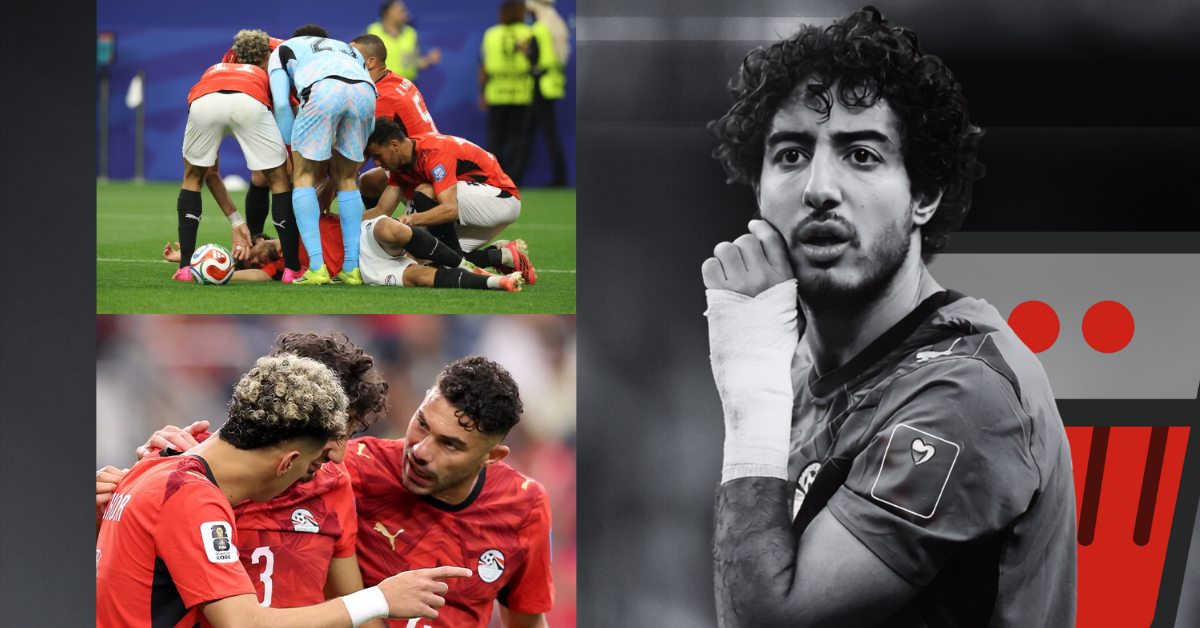
Egypt is heading to the Round of 16 after a historic victory over Australia. Yet somehow, one of the biggest talking points after the final whistle wasn’t the resilience that carried the Pharaohs through 120+ exhausting minutes—it was Mohamed Hany.
Within minutes, social media had reduced him to a statistic. Memes spread rapidly. His own goal was replayed over and over. Even in the post-match press conference, the jokes continued.
But somewhere between the memes and the mockery, another story disappeared. The story of a player who spent much of the match putting his body on the line for his country.
Football has always been a sport of defining moments: a goal, a missed chance, a costly mistake. These snapshots often become the lasting memory of an entire performance.
That is exactly what happened to Mohamed Hany. His own goal became the headline, while the physical toll of the match and everything he had done before and after that moment faded into the background.
For much of Egypt’s World Cup campaign, Hany has been one of the team’s most consistent performers. His defensive work, relentless running, and willingness to cover every blade of grass have been instrumental in Egypt’s journey to the Round of 16.
It’s not an exaggeration to say that, without performances like his throughout the tournament, Egypt’s campaign could have ended long before the knockout stage.
Yet football has a cruel habit of reducing 120 minutes to a single touch of the ball. One mistake became the defining image of his night, overshadowing the countless moments in which he helped keep Egypt alive.
What the viral mockery overlooks is that Hany had already endured a physically punishing night before the ball ever hit the back of his own net. He absorbed heavy challenges, took a painful knock to his knee, and later suffered a significant collision to the head that left him motionless on the ground while medical staff attended to him.
After treatment, he stood up and returned to the pitch, continuing to sprint and fight until the final whistle of extra time. Whether the medical assessment that allowed him to continue followed every appropriate protocol is something only the medical team and match officials can answer.
But the dangerous head collision deserves far more attention than the accidental deflection that followed just seven minutes later. Head injuries are among the most serious threats in modern sport.
Soccer has made significant progress in recognizing concussion risks precisely because symptoms are not always immediately obvious, and players themselves will often insist they are fit to continue out of pure adrenaline.
The conversation took a turn from standard fan critique to public humiliation during the post-match press conference. Egyptian journalist Ahmed Awes joked to defender Ramy Rabia that he should “play man-to-man defense on Mohamed Hany” in the next match.
Awes later issued an apology, explaining that the remark was made in a celebratory atmosphere and was not intended to mock Hany personally.
People will have different opinions on whether that apology is enough, but the larger issue goes beyond one specific joke. Press conferences exist to inform the public, challenge tactical decisions, and give players an opportunity to explain what happened on the pitch.
For any sports journalist, the end goal is to cover the World Cup. How on earth was the opportunity given to this journalist, who is a professional with years of experience, yet this is the question he chooses to ask? Why was this man given the opportunity while there are hundreds, if not thousands, of other journalists who would kill for such an opportunity?
When a player who has just endured one of the physically and emotionally toughest nights of his career becomes the press room punchline, it reflects a wider, toxic culture where athletes are treated as content before they are treated as people.
Football invites criticism, and every professional player understands that. But the point here is simple: public humiliation is something else entirely.
None of this means Mohamed Hany should be immune from tactical critique. Mistakes happen, and professional footballers are rightly judged on their performances. But criticism should never erase the human context of what came before it.
For 120+ minutes, Hany continued to defend, overlap, recover possession, and fight for every ball. He did not ask to come off. He did not disappear or hide from the ball after making a mistake. He kept playing with the true grit of a professional. That resilience does not erase the own goal, but the own goal should not erase the full story.
Perhaps that is the real lesson from Egypt’s victory over Australia. The easiest thing to remember is the mistake, but the harder—and far more important—thing is remembering the person behind it.
As Egypt prepares for its massive Round of 16 clash with Argentina, Mohamed Hany deserves to be judged as a footballer, but he should also be remembered as a human being who gave everything he had on the pitch that night. Football will always remember statistics, but journalism should remember the full story.