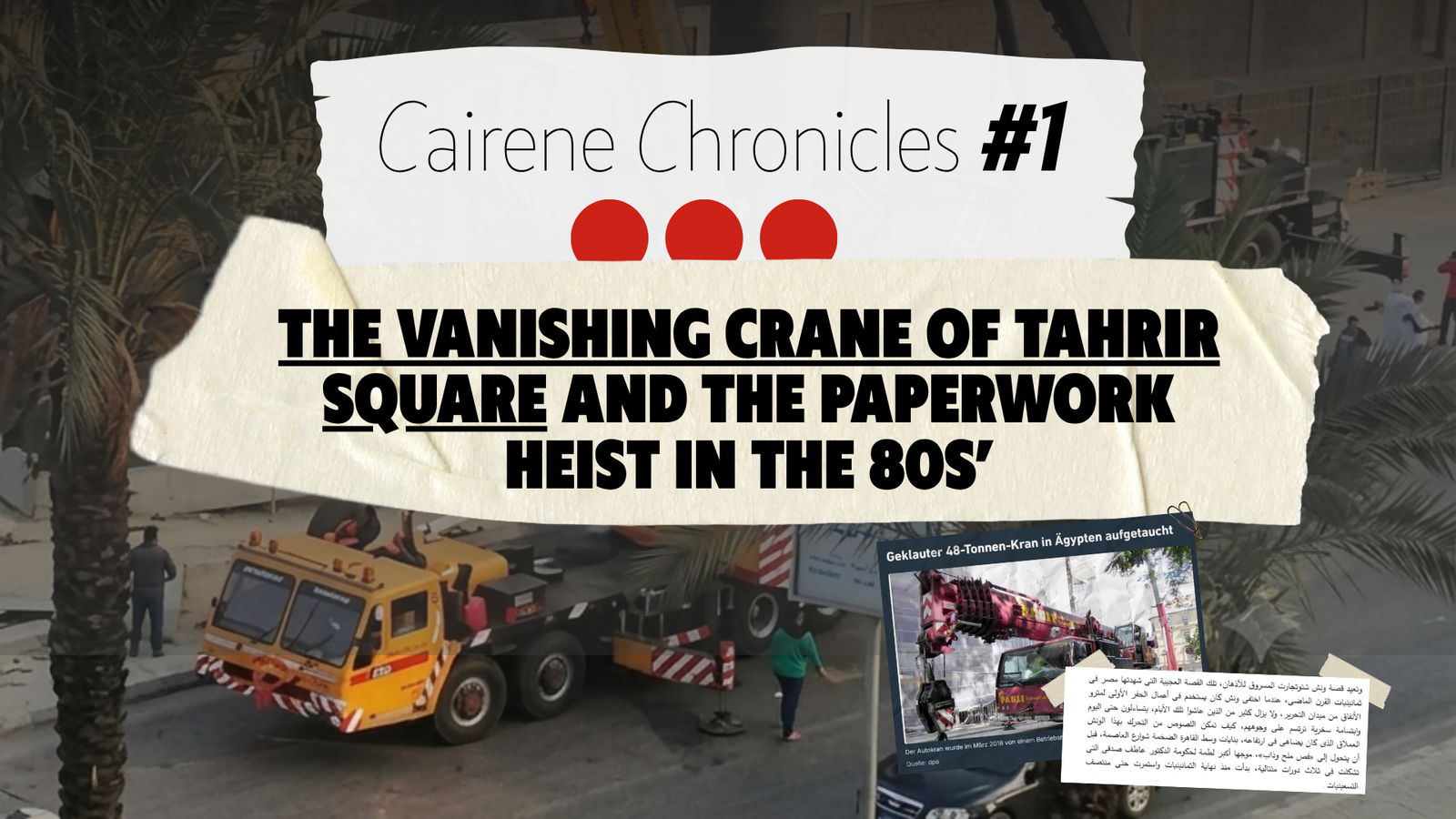
In Egypt in the 80s, criminal creativity operated on an entirely different scale, the vanishing crane of tahrir square.
Forget about slipping a diamond ring into a pocket. The local folklore prefers the boldness of walking away with heavy construction equipment.
Specifically, giant cranes. Egypt in the 1980s was struggling with rapid urban development, economic pressures, and a complex bureaucracy, creating conditions in which corruption sometimes prospered in plain sight. For decades, the country has been consumed by tales of disappearing machinery, leading to a mix of urban legends and international mysteries that still puzzle the public today.
The Ghost ‘Winch’ of Tahrir Square
The most enduring legend dates back to the late 1980s, during the grand construction of the Cairo Metro. French companies had arrived with advanced equipment to dig under the busy streets of the capital.
Then, the unthinkable happened. Right from the middle of Tahrir Square, one of the most crowded and heavily monitored locations in Cairo, a massive construction crane vanished.
According to Al Ahram, the news of the theft stunned the entire nation. People opened their morning papers to find that a giant piece of machinery, comparable in height to the surrounding downtown buildings, had simply evaporated.
How does anyone sneak a multi-ton crane through the chaotic traffic of Cairo without anyone noticing?
For years, the public guessed wildly. A few swore it was chopped up and melted down into scrap metal, while others joked that local geniuses had somehow smuggled it across the border. The case was eventually closed against an unknown perpetrator, producing a legendary riddle that lasted for nearly thirty years.
The Paperwork Phantom
While the public imagined a physical midnight heist, a popular and far more intricate alternative version of the story emerged over time.
In this telling, the crane was never actually driven away by a daring crew of thieves because it never existed in the real world to begin with.
According to this version of events, a clever group of port and customs officials realized they could exploit the bureaucracy. They managed to process the purchase of a two-million-pound crane entirely on paper.
The shipment arrived on paper, it was delivered to the metro site on paper, and it supposedly spent months digging in Tahrir Square on paper. The phantom crane even had a certified maintenance schedule and a fully trained driver, who collected a salary on paper.
The illusion only shattered when an unsuspecting junior engineer checked the inventory logs and asked to use the machine, only to find an empty patch of dirt.
To cover their tracks, the corrupt officials panicked and reported it stolen, even bringing in fake witnesses to swear they had seen the mechanical giant working under the sun.
The group of customs and port officials managed to complete the entire fraud on paper.
They authorized a budget of approximately 2 million Egyptian pounds for the fictional purchase of the crane. After a short period, they successfully withdrew the funds, divided the money equally among themselves, and went about their business.
Because the administrative trail looked perfect, the scheme went entirely unnoticed by the authorities, and nobody suspected anything until much later.
It stood as a masterpiece of administrative fiction that proved sometimes ink can be stealthier than a crowbar.
From Tahrir to Stuttgart
The fascination with missing machinery took an international turn decades later when European law enforcement faced a similar headache.
In early 2013, German authorities in Stuttgart were confused by the disappearance of a forty-eight-ton crane from a local construction site.
The owner offered thousands of euros in rewards, and European ports were put on high alert to stop the massive vehicle.
The global police network was left red-faced when the missing German giant casually rolled into the port of Alexandria.
The nerve of moving a restricted, stolen piece of heavy European industrial equipment across borders and oceans perfectly paralleled the old Tahrir Square myth. And yet again, it remained unknown who stole and moved the crane across the sea into a random, unprecedented area in Alex.
It proved that, whether by old-school smuggling or masterminded paper trails, the legend of the disappearing crane is an art form that never really goes out of style.