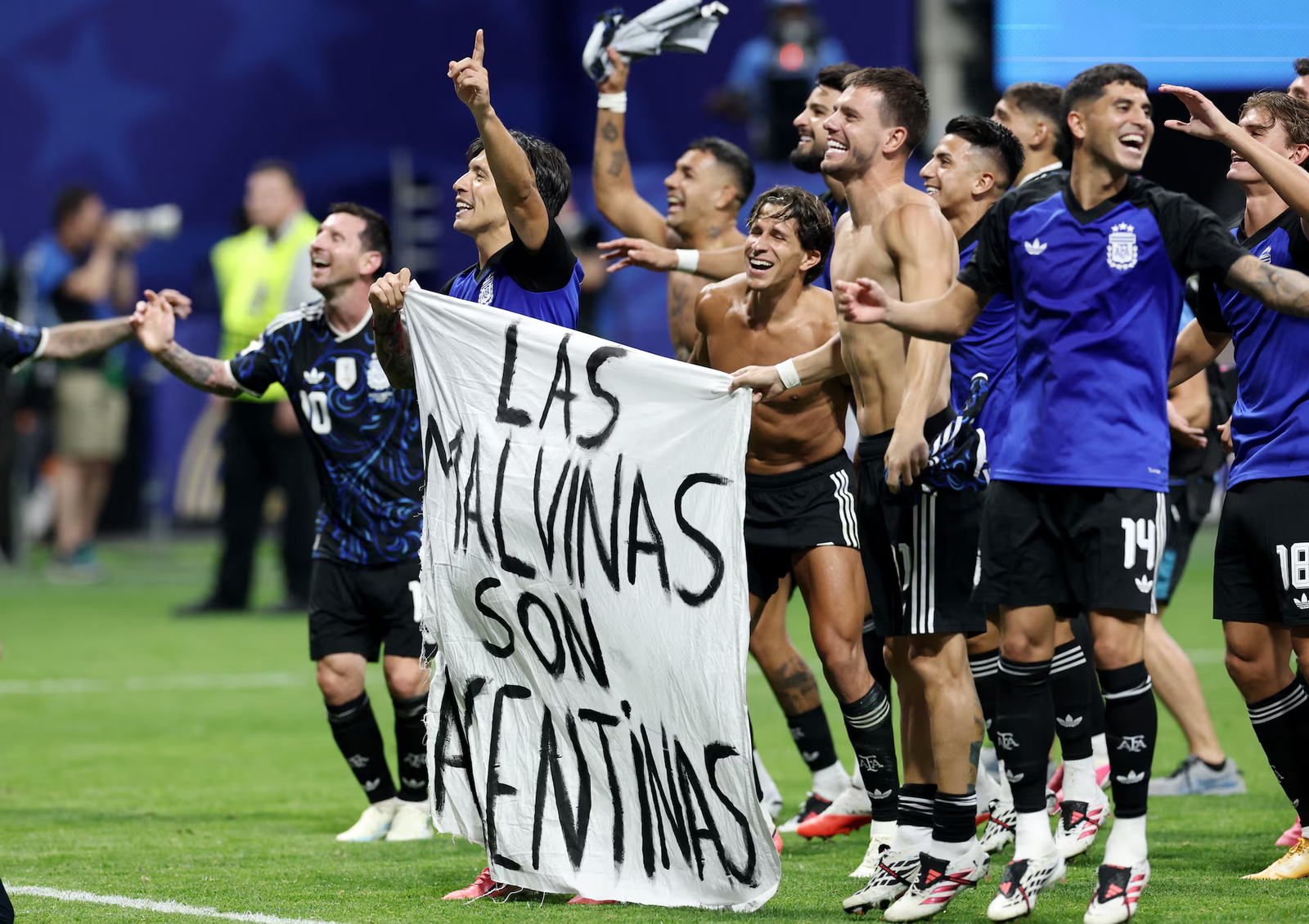
After their semifinal victory over England, Argentine players cheered on the pitch with a fan-made sign claiming the Falklands Islands. What does it mean?
Argentina’s 2-1 win over England in the World Cup semifinal set off celebrations that quickly moved from the pitch to the stands. Midfielder Giovani Lo Celso and defender Lisandro Martínez picked up a fan’s banner and brought it back onto the field. Almost the entire team assembled behind the banner to celebrate with their fans.
The sign read “Las Malvinas son argentinas,” or “The Malvinas are Argentine.” For Argentina, this is more than a slogan; it’s a direct claim to the British-controlled Falkland Islands, a territory that triggered a short but deadly war between the two countries in 1982.
A Global Red Card: The Banner, the Border, and the Backlash
Argentina isn’t the most loved across the world right now, and what they just did made it even worse, both professionally and globally. While the game is designed to literally unite, mixing it with century-old border disputes is, quite frankly, an own goal.
FIFA’s strict neutrality rules exist for a reason: they are intended to keep the focus on athletic performance rather than serving as a megaphone for geopolitical disputes.
By rolling out a banner claiming the Falkland Islands, the Argentine team effectively dragged a complex, high-stakes conflict onto the pitch, directly defying pre-match security directives that banned political slogans from the stadium entirely. It is a classic case of failing to read the room, turning a triumph into an inappropriate diplomatic headache that inevitably invites more scrutiny than unity.
The Irony and the Paradox of the Claim
The backlash extends far beyond football regulations, touching on the deep historical contradictions embedded in Argentina’s anti-colonial narrative. By parading the banner, the team actively brushed aside the democratic reality of the people living on the islands today.
In a 2013 referendum, 99.8% of the local population voted to remain a British Overseas Territory. While the UK and the islanders view forcing Argentine rule on them as an act of modern colonization, Argentina considers the current inhabitants an “implanted population” brought in after Argentine settlers were expelled in 1833, arguing that an occupying population cannot claim the right to self-determination.
Compounding this tension is the glaring historical irony of the “colonizer” label itself. When Argentine figures attack Britain as imperialists, they overlook the fact that modern Argentina is a nation built on European colonialism, established by Spanish conquistadors who displaced indigenous populations, and later populated by waves of European immigrants.
Critics point out the paradox of a nation formed by European settlers accusing another European nation of colonization on an island that was entirely uninhabited before Europeans arrived. By using a football pitch to revive a message tied to the 1982 war, which cost over 900 lives, the players reopen deep historical wounds rather than bridging them.
Could Argentina Be Punished?
The celebration quickly moved from football to geopolitics. FIFA and IFAB have strict rules against political messages on the field, and the regulations are clear: players and teams are not allowed to display political slogans, statements, or images during or after matches.
Since the banner appeared on the field, Argentina’s team now faces a disciplinary review. This isn’t the first time; back in 2014, FIFA fined Argentina for a similar incident before a friendly against Slovenia.
What Happens Next?
Severe athletic punishments are rare, but football’s governing bodies often hand out fines to national teams that allow political messages on the pitch.
With Argentina set to play Spain in the World Cup final on Sunday, it’s unlikely that any players will be suspended or face immediate athletic sanctions. FIFA is expected to investigate, so the Argentine Football Association will probably face a hefty fine before the final kicks off.
What do you think? Should FIFA enforce stricter athletic penalties for political displays on the pitch, or are fines enough?