
The recent wave of backlash directed at actress Aya Samaha following a celebratory anniversary photograph with her husband Mohamed Sebaie exposes a familiar, frustrating pattern in contemporary societal discourse in Egypt.
The digital public square in Egypt has once again transformed into a courtroom of selective morality, where the boundaries of personal freedom are dictated by deeply ingrained gender biases.
When a woman expresses affection within the legal and social sanctity of marriage, it is branded as an existential threat to public decency. Yet, when a prominent man commits an actual, documented violation of personal boundaries, the narrative miraculously shifts toward forgiveness, human frailty, and spiritual grace.
The controversy ignited when Samaha shared a photograph marking her wedding anniversary on May 14th, capturing a brief, affectionate kiss shared with her husband.
For a segment of the public, this intimate celebration of marital love was treated as a scandalous violation. Critics quickly rushed to the comments sections and social media feeds to condemn the image as inappropriate, exhibitionist, and a degradation of traditional values.
People even started tagging the Ministry of Interior’s page to take action on the ‘vulgar’ picture.
Among the voices shaping this outrage was “Islamic researcher,” influencer, and proud misogynistic, Abdullah Rushdy. Taking to his platform days after the image went viral, Rushdy published a critique without naming Samaha directly, declaring that it is “utter vileness for a married couple to exchange kisses in the presence of the public.”
He went further, saying that there is a harmful cultural trend trying to get rid of modesty and moral values, and even compared public affection between married couples to the behavior of animals in the street.
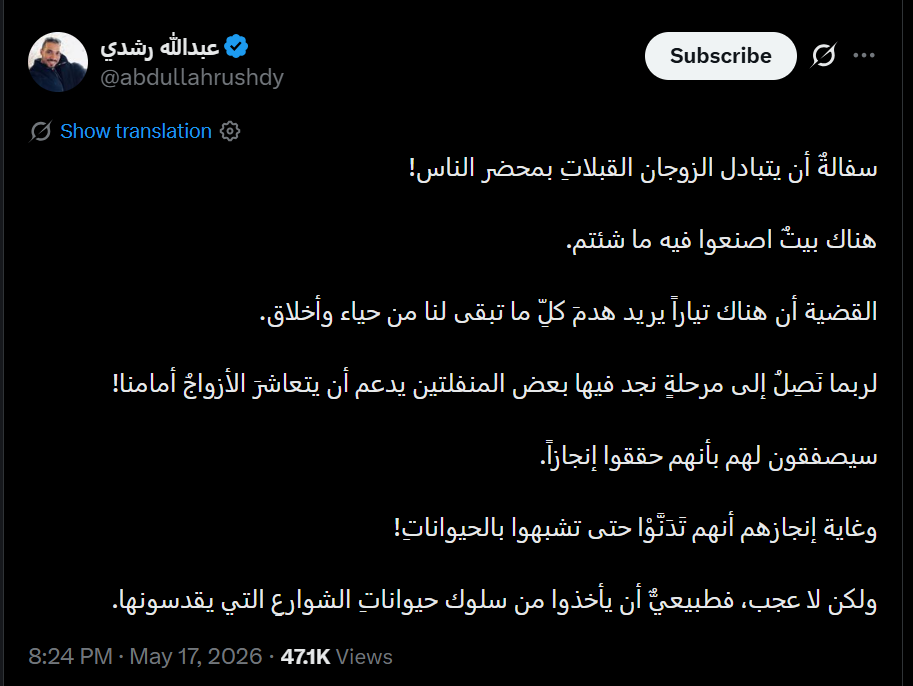
The harsh criticism in Rushdy’s statement is not just an expression of conservative values; it is an intentional escalation that reframes a private, joyful moment between a husband and wife as a societal crisis.
Adding to that, many people are viewing this opinion as the norm. A literal ‘halal’ married couple should not express their love. Whether through pictures or even privately. Many view that expressing love between a man and his wife is ‘embarassing’ rather than actually having its purpose.
By asserting that a home exists to conceal anything a couple wishes to do, such arguments, reduce all forms of marital affection; even a harmless kiss on an anniversary; to the level of explicit acts that must be hidden away in shame.
This rhetoric actively strips individuals, particularly women in the public eye, of their personal control and their right to define their own boundaries of self-expression. It propagates the idea that a woman’s joy, even when shared alongside her husband, is a public commodity subject to policing, shame, and dehumanizing comparisons.
However, the true hypocrisy of this moral care becomes undeniable when contrasted with past commentary from the exact same figures.
To understand the profound double standard at play, one only needs to look back to June 2019, during the Africa Cup of Nations, when Egyptian national football player Amr Warda was involved in a massive scandal involving leaked, highly inappropriate, and predatory messages sent to multiple women online.
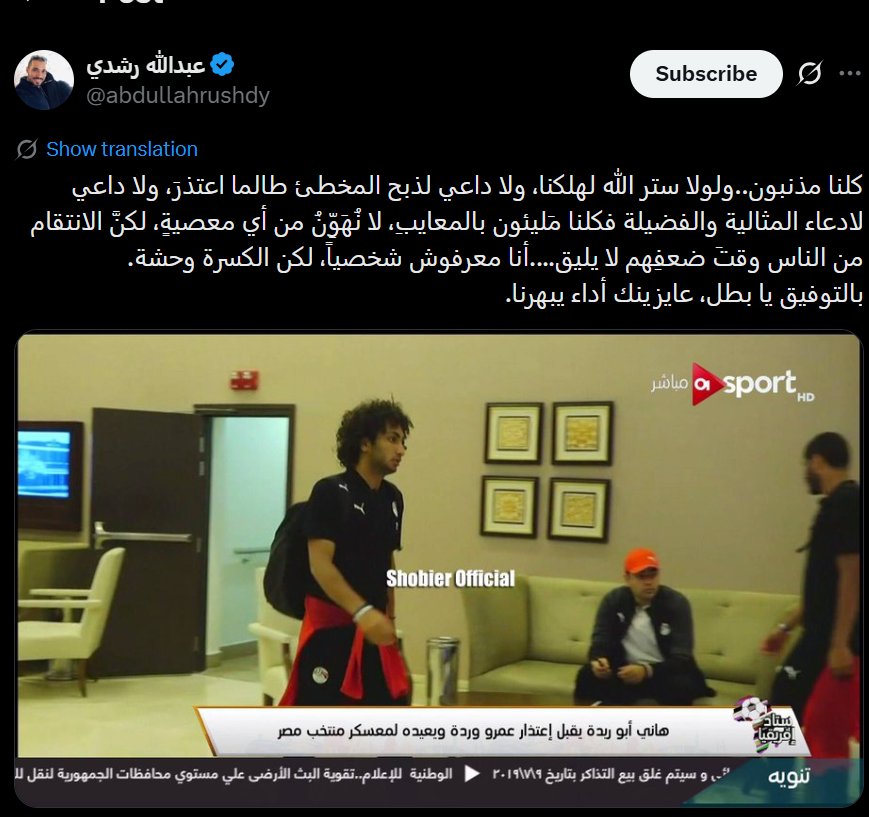
The incident was not a display of consensual marital affection; it was a clear breach of ethical behavior that disrupted the national team and sparked widespread public condemnation.
During that crisis, the tone from conservative commentators like Abdullah Rushdy was radically different. Rather than weaponizing terms like vileness or accusing the athlete of dismantling societal morality, Rushdy advocated for leniency, compassion, and privacy.
He reminded his audience that ‘everyone is a sinner and that there is no need to slaughter the wrongdoer as long as he apologizes.’
He urged the public not to claim perfection, arguing that taking revenge on people during their moments of weakness is inappropriate, and concluded by wishing the player success and calling for a performance that would dazzle the nation.
The contrast of these two responses reveals a glaring systemic bias. A male public figure caught in an act of genuine
misconduct is afforded subtle detail, empathy, and a reminder that human beings are inherently flawed but deserving of a second chance.
This selective outrage proves that the criticism directed at Aya is not actually about defending abstract moral principles or protecting public decency. If public decency were the primary concern, a documented incident of digital harassment would be met with far greater severity than a photograph of a married couple kissing.
Instead, the outrage is about control. It is about enforcing a rigid social hierarchy where women are expected to carry the entire weight of a society’s perceived honor, while men are routinely absolved of their actual transgressions under the guise of religious tolerance and brotherly solidarity.
Personal freedom, especially within the bounds of a consensual, legal marriage, should not be subject to the shifting winds of internet tribunals or the self-serving rhetoric of religious influencers.
Aya Samaha and her husband have every right to celebrate their relationship in the manner they choose, and a simple expression of love should never be equated with moral decay.
True societal progress requires dismantling these glaring double standards, recognizing that personal freedom is an individual right, and refusing to allow public morality to be used as a weapon that selectively shames women while coddling men.
The reaction to Aya Samaha and her husband’s anniversary kiss exemplifies the hypocrisy in societal expectations, where women’s expressions of love are vilified while men’s indiscretions are overlooked. Challenging these double standards is essential for fostering a just society that values personal freedom for all.