At the premiere of Khareetet Ras El Sana, Riham Abdel Ghafour was not dealing with criticism, controversy, or even press pressure in the usual sense. She was dealing with something far simpler and far more disturbing: being filmed without consent, inside a cinema hall, during a private screening, by pages that had no right to be there in the first place.
The premiere itself was unremarkable in the best way. Standard red carpet interviews, invited media outlets, normal coverage, and then a private screening inside the cinema. This format has become routine in Egypt’s film industry. Red carpets are public-facing; screenings are not. That distinction matters, or at least it should.
What happened next is where the line was crossed.
Inside the Cinema Is Not Public Space
Phones are strictly not allowed inside private screenings. This is not an unwritten rule or an industry preference. It is a basic condition agreed upon by cinemas, distributors, and invited media. Yet during the screening, Riham Abdel Ghafour was filmed repeatedly inside the hall by unauthorized pages, clearly uncomfortable and visibly aware that her personal space was being violated.
These were not flattering shots, posed moments, or coverage tied to the film. They were intrusive clips taken while she was seated, trying to watch the movie, exist quietly, and momentarily step away from the performance required of public appearances. Moments that should never be filmed, let alone published.
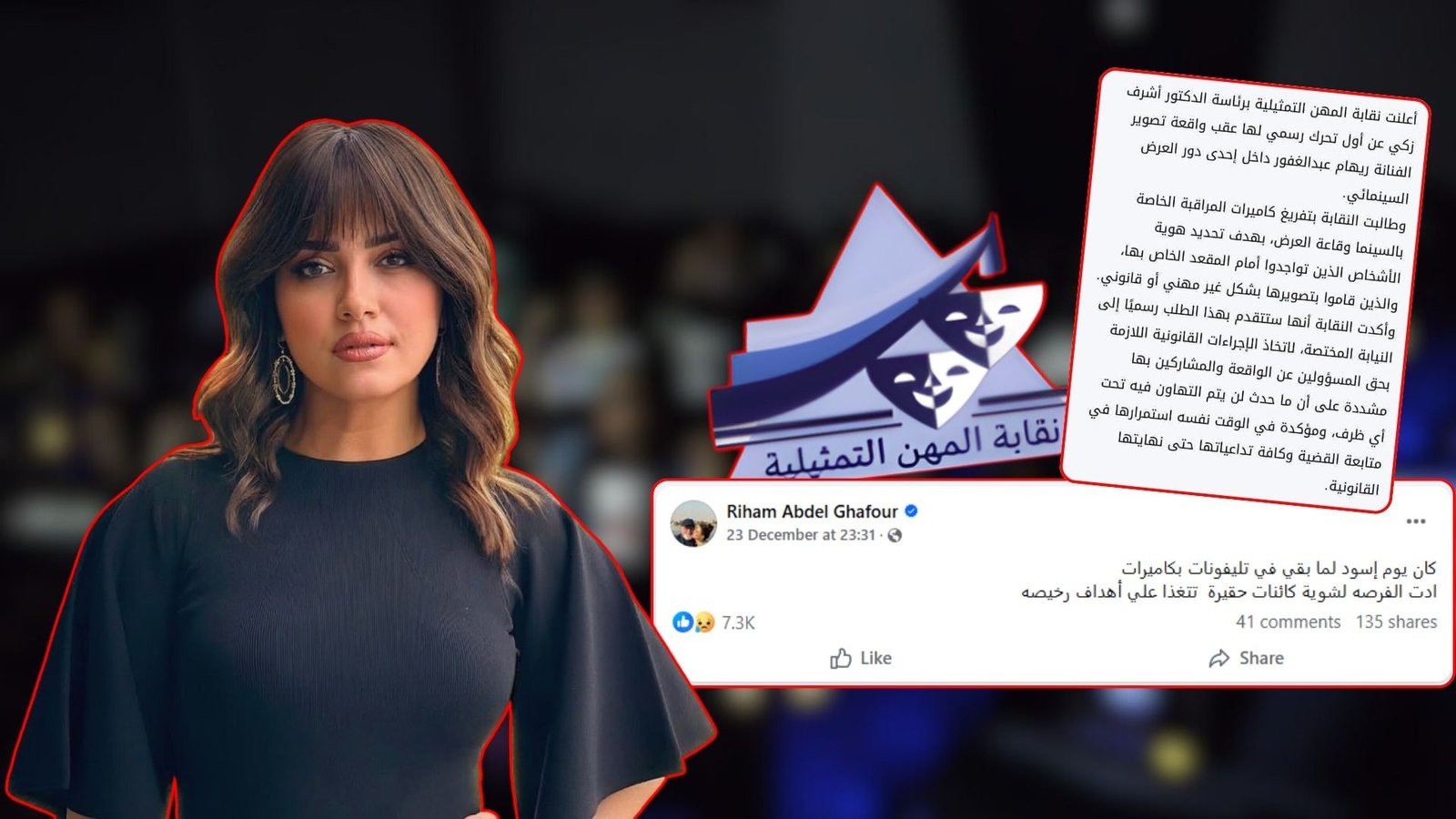
Riham later addressed the incident on Facebook with a blunt honesty that resonated widely, writing:
“It was a dark day when phones got cameras, giving some despicable creatures the chance to feed on cheap targets.”
Her words were not about fame or ego. They were about boundaries, dignity, and how easily technology has been weaponized against basic human privacy.
The Actors’ Syndicate Responds
Following the incident, the Actors’ Syndicate issued an official response, confirming that it would formally request CCTV footage from the cinema and screening hall in order to identify those responsible. The syndicate stated that legal action would be taken against everyone involved, emphasizing that violations of privacy inside private screenings will not be tolerated and that the case will be followed through its legal course.
Ashraf Zaki, head of the syndicate, also issued a clear warning that there would be no leniency in dealing with such violations. He stressed that targeting artists in this manner is not merely a personal offense but a direct harm to the image of Egyptian art and the industry as a whole, adding that legal accountability would extend to individuals, pages, and platforms involved in producing or circulating such content.
Right after, the Syndicate filed an official complaint with the Supreme Council for Media Regulation against the media outlets and their affiliated pages for offensive, completely unprofessional content targeting Riham.
So Where Is the Line?
This is not a conversation about celebrities being “too sensitive,” nor is it an attack on the media as a profession. It is about recognizing that access is not ownership, that visibility is not consent, and that being a public figure does not erase the right to privacy in private spaces.
Red carpets, premieres, and screenings do not cancel a person’s humanity. They do not justify a camera in every moment, especially when the rules explicitly say otherwise. Until organizers enforce access, platforms take responsibility, and violations are met with real consequences, these incidents will continue to repeat, and artists like Riham Abdel Ghafour will continue to pay the price for a system that refuses to draw clear lines.
The real question is no longer what happened.
It is why it keeps being allowed to happen at all.