
At Friday’s Arab-EU summit, the Egyptian president delivered his most comprehensive foreign policy speech of the year, outlining Cairo’s positions on Gaza, Lebanon, Sudan, Iran, and migration.
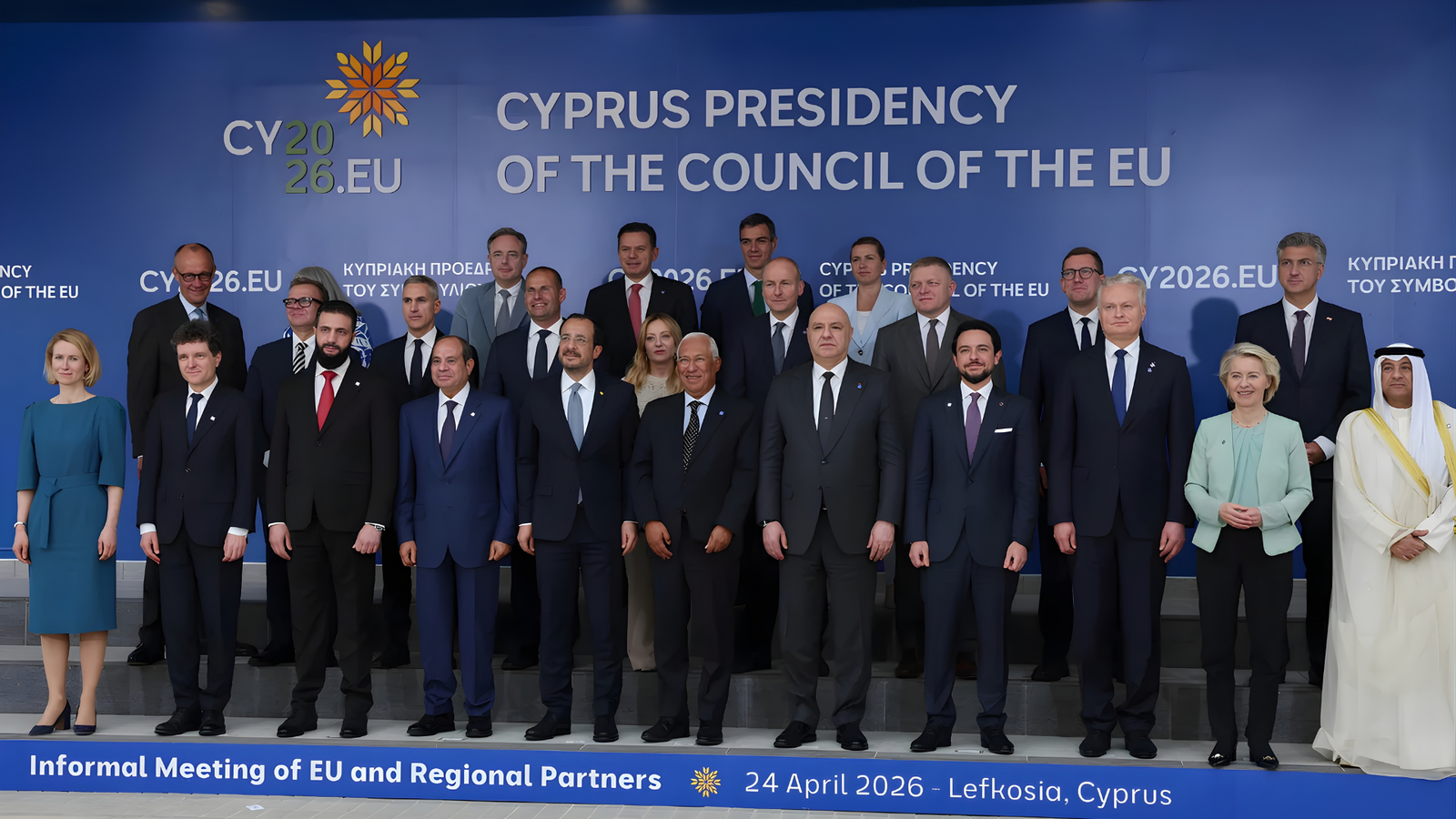
On April 24, 2026, President Abdel Fattah El-Sisi attended a consultative summit in Nicosia with leaders from several Arab states, EU heads of government, European Council President António Costa, and European Commission President Ursula von der Leyen.
Cypriot President Nikos Christodoulides opened the meeting, joined by Costa and von der Leyen. By the end of the day, El-Sisi had delivered a comprehensive address, held seven bilateral meetings, and outlined Egypt’s positions on key regional issues.
The Opening: A Shared Mediterranean Fate
El-Sisi began by thanking Christodoulides and Costa for the invitation and emphasized the meeting’s importance. He noted that ongoing crises and conflicts in the Middle East have long undermined hopes for stability and development.
He argued that both Arab and European shores of the Mediterranean face shared consequences from regional crises. He stressed that Europe is particularly affected, making joint action essential.
On Iran and the Gulf
El-Sisi addressed the Iranian crisis, highlighting its impact on regional stability, navigation, and the global economy, particularly in energy, food security, supply chains, and the risk of nuclear contamination.
He condemned Iranian attacks on Gulf states, Jordan, and Iraq, calling them unacceptable under any circumstances.
He affirmed Egypt’s full support for the security of Arab states, stating it is inseparable from Egypt’s own national security. He added that any future agreement on Iran must address Gulf states’ security concerns.
On Navigation and Political Solutions
El-Sisi stated that Egypt’s position is clear: only a political solution can resolve the region’s crises, and military options are unacceptable.
He emphasized Egypt’s commitment to freedom of navigation, stating that securing international shipping lanes is a fundamental principle of international law.
He called for a Middle East free of weapons of mass destruction and for comprehensive, non-selective implementation of the nuclear non-proliferation regime.
On Palestine: Four Points
El-Sisi described the Palestinian cause as central to regional crises and the Arab world, outlining four specific demands.
First, the Palestinian people must remain on their land, with all efforts directed at halting settlement policy and preventing displacement or the liquidation of the Palestinian cause.
Second, the Palestinian National Committee should assume administration of Gaza, with an international stabilization force deployed promptly to monitor the ceasefire.
Third, Israel must fulfill its first-phase obligations, and all parties should advance the implementation of the ceasefire agreement’s second phase.
Fourth, early recovery and reconstruction projects should begin immediately across the Strip.
He urged the EU to keep the Palestinian file at the top of its agenda, stating that establishing an independent Palestinian state within the June 4, 1967 borders and with East Jerusalem as its capital is essential for lasting peace.
On Lebanon and Sudan
El-Sisi identified Lebanon’s stability as a top Egyptian priority. He called for strict adherence to the ceasefire and urged international support to strengthen Lebanese institutions, end Israeli occupation, and halt attacks on Lebanese territory.
On Sudan, he reiterated Egypt’s firm support for Sudanese sovereignty and unity. He rejected any equivalence between state institutions and other entities and urged the EU to fully align its support with Cairo’s approach.
On Egypt-EU Relations and the New Mediterranean Pact
El-Sisi traced the Egypt-EU relationship from its origins through the 2024 Strategic and Comprehensive Partnership to the first summit in October 2025. He committed Egypt to the three tracks of the New Pact for the Mediterranean, whose first action plan was recently adopted: human development, economy and sustainability, and security and migration.
El-Sisi promoted Egypt as a potential industrial base for the EU and advocated joint investment in education, research, and technology transfer to create local jobs and reduce irregular migration.
Egypt now hosts about ten million people who left their countries under harsh conditions, with limited external financial support. He called for an integrated partnership focused on job creation, development, capacity building, and legal migration pathways for study and work.


