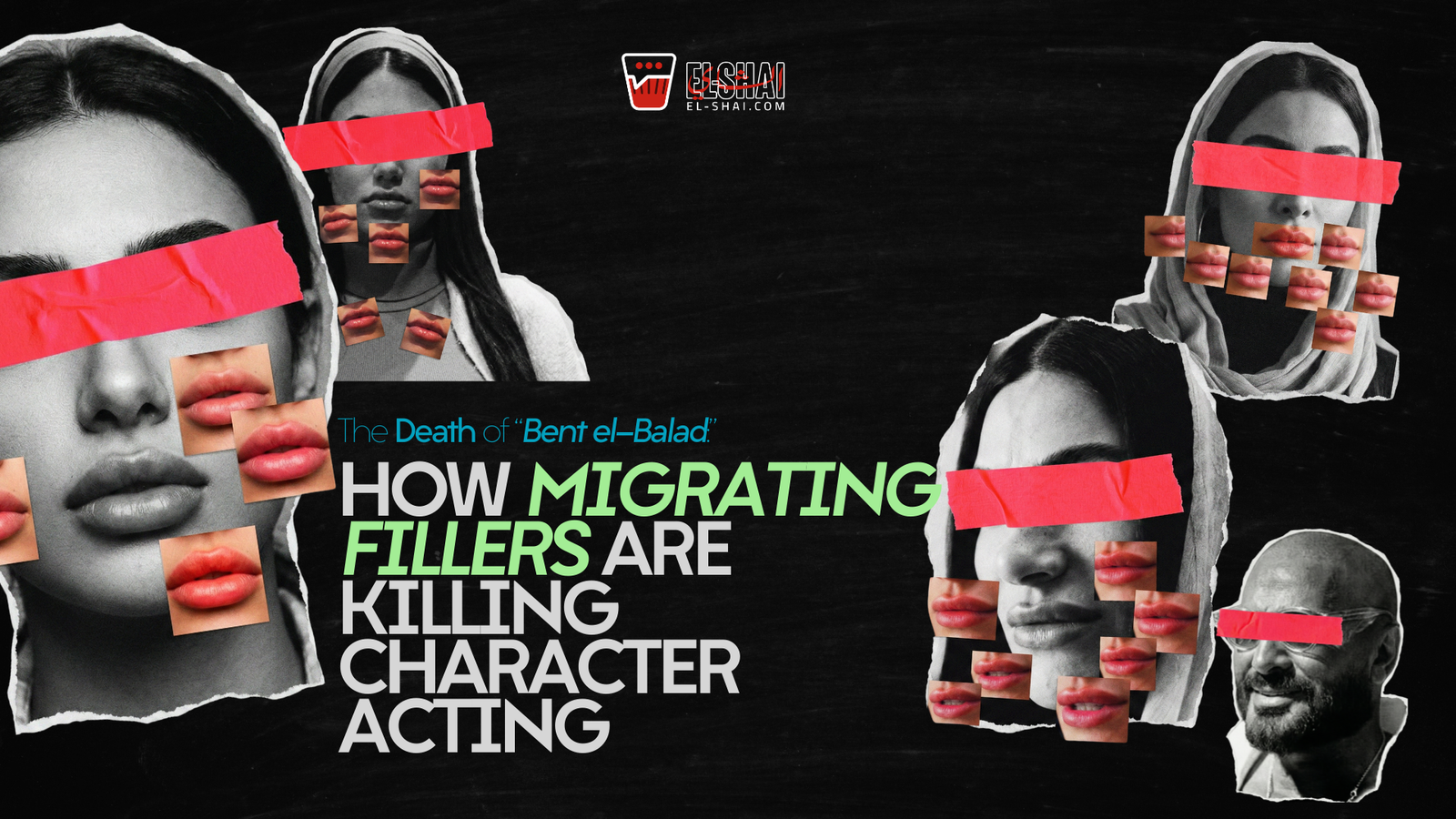
I’m tired of seeing the “designer face” on every everyday girl on my screen. From frozen expressions to the “duck-lip” pout, the industry’s obsession with Botox is breaking the fourth wall. Migrating fillers.
Open any channel now, and you’ll likely find a show centered on the “everyday” Egyptian girl—the Bint el-Balad or the Shaabeya heroine. Yet, more often than not, she appears on screen filled to the gods. With Botox frozen to the point of an uncanny valley, it feels less like a drama and more like an AI takeover. These aren’t characters anymore; they’re robots in galabeyas.
Now, before this is dismissed as an attack on cosmetic procedures, I am a woman with fillers. I have literally booked a “face change” of my own. But there is a fundamental difference between a private citizen and a professional performer. I am not an actress; my face is not my primary tool for storytelling.
The disconnect is jarring. Fillers and Botox are expensive—prohibitively so. It is impossible to stay immersed in a story about a girl “barely surviving” when she’s sporting a 30,000 EGP Texas jaw and lips that mirror Lola from Shark Tale. (Does anyone even remember that movie? Because the resemblance is getting distracting.)
Beyond the budget logic, there is the sheer quality of the work. Egypt is home to world-class cosmetic providers, yet we see actresses paid in the millions with migrating filler and “duck-lip” profiles. It isn’t just a “women’s issue,” either. Men in the industry are having a field day with injections, often ending up as comedic parodies of their former selves. When you can afford the best, why settle for a result that hinders your craft?
There is also a technical lack of discipline. Seeing fresh injection sites in high-definition close-ups is a production failure. If you’re going to alter your face, do it well before the cameras roll. It’s a matter of professional polish.
Ultimately, however, the blame lies with the directors. A director knows the actress they’ve picked won’t be able to convey a shred of nuanced emotion through a wall of Botox. They know a “rising star” with a cartoonish pout cannot realistically be cast as an underprivileged girl fighting for her life. Yet, they cast them anyway.
By prioritizing a specific, homogenized aesthetic over acting range and narrative logic, the industry isn’t just ruining faces—it’s ruining the art of Egyptian storytelling.