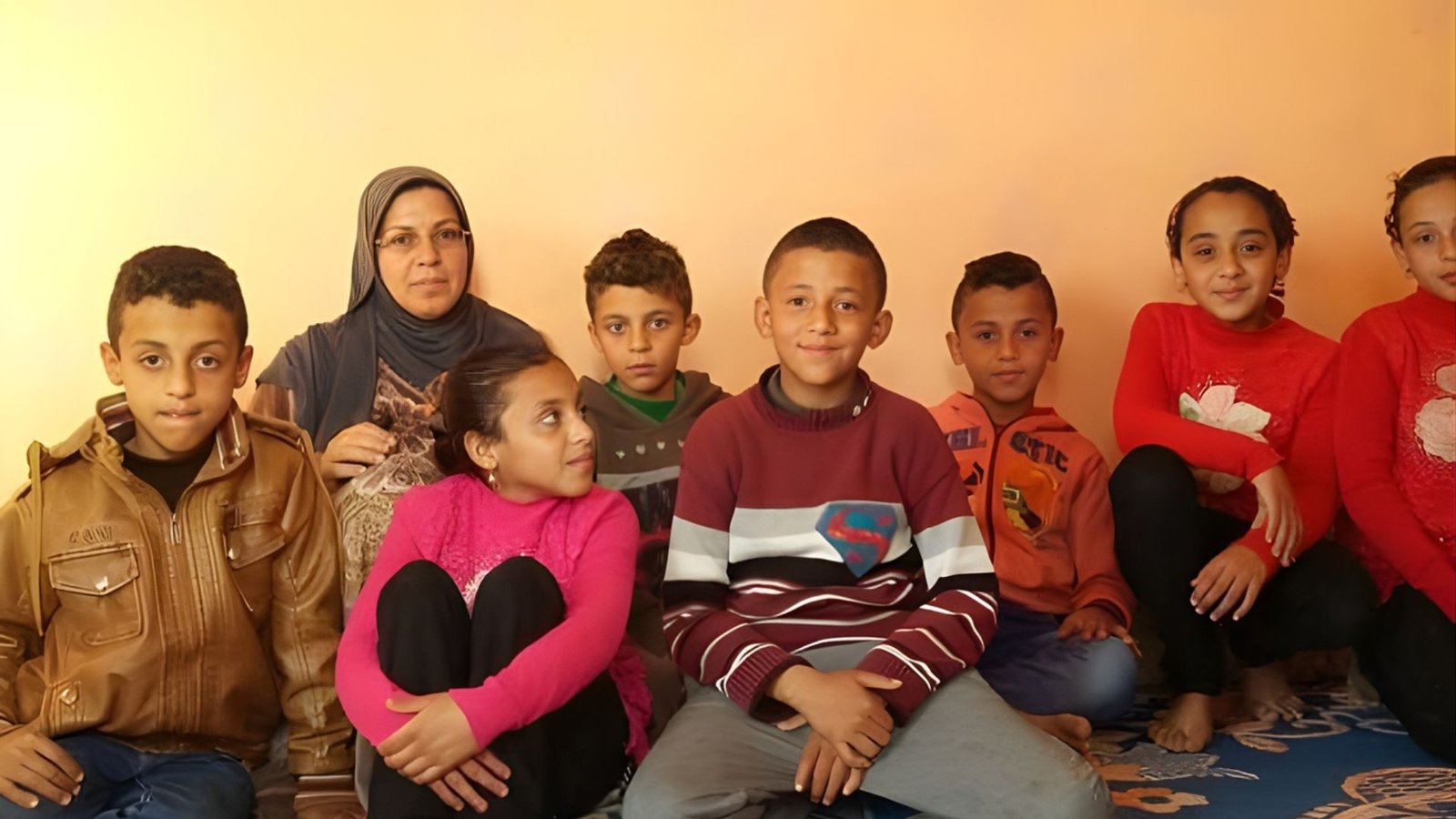
Long before the series turned septuplets into drama, a woman in Beheira lived the shock, the risk, and the lifelong bill of raising seven children at once, with almost no real safety net.
When people talk about Karset Tabee’ya, they talk about Mohamed and Shorouq, the shock of five babies turning into seven, the chaos in that tiny apartment, and the scene where a minister walks out before signing the paper that could save the family.
But 17 years before the series, a woman from a village in Beheira lived her own version of that storyline. No writers. No guaranteed character arc. No trending hashtag.
Her name is Ghazala Ibrahim Khamis Awad, and in 2008, she gave birth to seven babies at once, after a pregnancy that doctors called one of the rarest cases in the world.
For a few weeks, she was everywhere. Then Egypt moved on, and she did not.
The day Egypt discovered its own “natural disaster.”
In August 2008, news broke that a 27-year-old woman from Beheira had delivered seven babies in a single caesarean at Al-Shatby University Hospital in Alexandria. Four boys and three girls, all alive, all premature.
The story at the time made headlines everywhere as a rare medical event. One report described her as the second woman in the world to reach the eighth month and deliver seven live babies.
And not just that, but she already had three daughters.
She and her husband, Farag, a day-to-day agricultural worker, had been told she might not get pregnant again. Then doctors discovered her womb held nine fetuses.
A doctor suggested a “fetal reduction”. Keep two or three, terminate the rest.
The operation would have cost 4,000 pounds, money the family did not have, so she carried them all. Two fetuses died in the fifth month. Seven survived.
In her own words to Al-Masry Al-Youm ten years later, she said:
“I was pregnant with nine fetuses. Two of them died in the fifth month, and the doctors removed them during delivery. I delivered the rest in the eighth month. I could not move from my place in the last months of pregnancy.”
The birth was treated as a miracle. The reality that followed was not.
From miracle headline to daily survival
Media at the time loved the spectacle of seven tiny babies lined up in incubators in Alexandria. They loved the photos. The “strange but true” angle. They loved calling her “the mother of seven.”
Then they left.
By 2018, when Al-Masry Al-Youm decided to go back to her village, Omara in Housh Eissa, Beheira, they opened their piece with a simple point: for ten years, no one had really asked how she was living, how she was feeding them, or if the children were even still in school.
The seven, whose names she always lists in one breath, are Mohamed, Belal, Yous, Karim, Sara, Habiba, and Doaa.
Every basic expense was multiplied by seven. Then again by ten.
“The schoolbag that was 50 pounds became 170. How am I supposed to buy seven? If one child needs shoes, I need to buy seven pairs. Food is on seven plates. Medicine is seven times. Everything in my house is in sevens.”
Behind the viral “miracle birth” headline was a family that could not afford schoolbags.
Illness, unpaid work, and a state that arrives late
The story sounds dramatic on its own. In reality, it was even harsher.
Her husband developed bilharzia and long-term stomach problems. She developed diabetes and gallbladder issues.
Their daughter, Sara, had epilepsy and abnormalities in two parts of the brain. Her son, Mohamed, had chronic tonsil infections and a rib bone problem that required surgery.
Ghazala herself tried to work.
“I worked for a year at the village school without a single pound, and they promised to hire me. I submitted my papers, hoping to get a job so I could help my husband with the kids, but after a year, they said there was no position,” she told Masry Al Youm.
The family received a temporary assistance pension: first 200 pounds a month, then 300. It had to be collected from the Social Solidarity Directorate in Damanhour. Transporting two people to collect the 300 pounds costs around 50 pounds per trip, including standing in line and taking the money.
In 2022, in her interview with Sky News Arabia, she summed up the situation in one sentence:
“My husband and I both have diabetes, and he still has no permanent job. His daily wage does not exceed 3,000 pounds a month, and one of the children had heart surgery while another has brain atrophy.”
The miracle babies were now teenagers. The story had moved from “rare medical case” to something far less telegenic: a family stuck in a loop of illness, debt, and unstable work.
The scene that never aired
One of the most talked-about moments in Karset Tabee’ya is the scene where the minister leaves before signing the document that would help Mohamed and Shorouq survive with their seven babies. It sparked anger because it felt familiar.
In Ghazala’s life, that scene never needed to be written. It happened in slow motion for years.
When Al-Masry Al-Youm sat with her in 2018, she did not quote a minister or call for a specific official. She went straight to the top in her head.
“How did the officials not tell President Sisi about my situation? What can 300 pounds do for seven children who need food, clothes, bags, lessons, and medicine?”
She was not asking for luxury. She was asking for the basics: the ability to buy seven schoolbags at the start of the year without having to choose who gets one and who waits.
That is the part drama usually compresses into a montage. In real life, it stretches over years.
When fiction catches up with her
The success of Karset Tabee’ya pushed her story back into the feed. Commenters started calling Ghazala the “real-life heroine” of the show. Sky News Arabia ran a piece titled “The real heroine of Karset Tabee’ya… meet the mother of seven.”
In the show, Mohamed and Shorouq’s life turns upside down when a pregnancy that started as five fetuses becomes seven.
The series mixes comedy with the very real stress of surviving Egypt’s economic crisis with children you literally did not plan for and cannot ignore.
Ghazala lived in that mix: surreal, sometimes absurd situations sitting atop a serious structural problem.
In the Sky News interview, she described how a wealthy woman once offered to buy one of her daughters in exchange for money and a building. She refused.
“My children are a piece of my own flesh,” she said.
There was even an offer from abroad to sponsor the family and move them out of Egypt. They declined and chose to stay.
The difference between the show and her life is simple. In the series, the minister is forced to confront the consequences of walking away. In her reality, most people did.
The ministry responds to a fictional family, then calls the real ones.
After the Karset Tabee’ya scene of the minister leaving the desperate couple, Egypt’s Minister of Social Solidarity, Dr Maya Morsy, publicly responded.
She wrote about how that moment triggered internal questions inside the ministry about what they would do if “Mohamed and Shorouq” were real.
A few days later, the ministry invited any family with seven multiples to contact them and meet the minister, specifying the time and place in the New Administrative Capital, and asked families to send their phone numbers in a message so the team could schedule appointments.
On paper, that sounds like exactly the bridge everyone wants between drama and reality. A fictional scene leads to a policy response.
The question is what happens after the meeting.
Because Ghazala’s story tells us something uncomfortable: support that comes late, is temporary, or is only in response to public pressure does not fix the structure that created the crisis in the first place.
The real “Karset Tabee’ya” was never the babies.
If there is one thing that comes through from every interview Ghazala has done, it is this: she never regretted her children.
She struggled, broke down, and got sick, but she did not frame them as a burden.
What hurt her was being turned into a story and then left to carry it alone.
In 2018, she said, “I am exhausted, just want to raise the children and educate them.”
In 2022, she repeated that the seven will not be denied an education, no matter how hard it gets, because that is the one thing she and her husband can still promise them.
Karset Tabee’ya works because it feels realistic. It shows how quickly a family can slide from “barely managing” to “full crisis” after one life event.
Ghazala is the proof that this is not just screenwriting. It is policy, economics, and who gets long-term support and who gets a headline.
So if we are going to celebrate the show for starting a conversation, we have to ask the next questions too.
What does real, consistent support for families like Ghazala’s look like, beyond a one-time meeting or a short-term pension?
And should that support only start at seven children, or do we need to rethink how we treat any family that is one crisis away from collapse, even if they “only” have three or four?
Because for Ghazala, the real natural disaster was never the number of babies.
It was trying to raise them in a system that still treats her life like a plot twist instead of a responsibility.