Content Warning: This article contains detailed accounts of sexual harassment, assault, and abuse involving minors.
In Egypt, there are currently several cases taken to court about school staff sexually assaulting students. Many people have been questioning whether it’s something new, but the reality is, it’s always been this way.
These aren’t isolated incidents that suddenly appeared. They’ve been happening for decades, hidden behind closed doors, hushed up by administrators, laughed off as jokes, or dismissed entirely.
I decided to share my story. But I knew I wasn’t alone. So I created an anonymous forum where others could share their own stories too. What came back confirmed what I already suspected—we went to different schools, in different neighborhoods, in different decades.
Some were harassed by teachers, others by staff, and some by their own classmates. Some spoke up and were ignored. Others were blamed. Many stayed silent for years, carrying the weight of what happened in places that were supposed to keep them safe.
This isn’t just my story. It’s our story. And it’s time we finally talked about it.
My Personal Account of Silence and Complicity
Personally, I’m a 34-year-old woman, and I’ve been harassed by a school driver when I was 8.
The driver used to rent the canteen from the school, an international school that prided itself on being a safe space.
I later found out that this driver had also been selling drugs to students at this canteen.
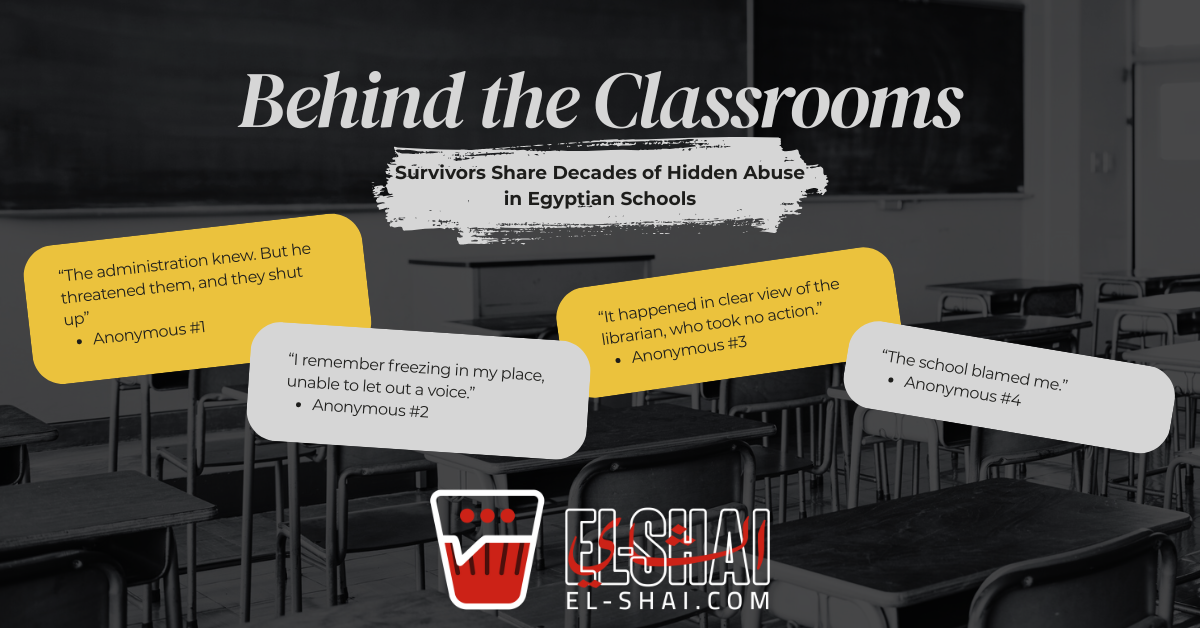
The worst part is that I learned the administration knew. But he threatened them, saying he’d tell the authorities they’d illegally rented their canteen to him, and they shut up.
This early experience exposed a chilling dynamic: institutional complicity that prioritized reputation over student safety.
The abuse wasn’t limited to one individual. I also learned that one of the cleaning ladies used to harass female students all the time.
On top of it, she started a rumor that those girls were lesbians and had sex in the bathrooms.
This pattern of harassment, coupled with malicious rumor-mongering, illustrates a culture where the vulnerable are targeted and further shamed.
I later moved to another school, and it was somehow worse. Students would harass each other.
I remember seeing a girl in grade 10 sexually assault a boy in grade 3, and it was taken as a joke by everyone, including teachers.
There was also a teacher who was obsessed with proving that the girls were sleeping together. I used to take a private lesson with him, and he would always tell my mom explicit things about the girls in my class.
I knew them, and I knew this wasn’t true. He would even give examples of events and times when I’d be there, and none of it was true. I was always confused as a child, but as I grew up, I realized it was a form of a sick and twisted fantasy he had.
Years later, during my SAT exam preparation, I took a private lesson at my home where other students would come.
The teacher would touch the boys’ privates and say that if they don’t answer right, he’ll “squeeze their dicks.” It was always played off as a funny bit in class, but I always felt weird about it.
Then one time, we had a new guy take the class with us. He showed interest in me, but I wasn’t interested in him. The teacher later told me he was rich and that I should get with him. And if I don’t, he’ll stop giving me classes. I stopped taking the classes.
Then at university, the dean would constantly harass and belittle the girls in class. He would sexualize us at any given opportunity and would make the class laugh at us.
One time, he asked me to go to his office, and when I did, his penis was out, and he pretended he didn’t notice. When I started screaming at him, he told me he’d never let me graduate.
The repercussions were severe and prolonged. It took me three extra years to graduate. I was the one who would make classes at home to teach my colleagues and would help them cheat, and I’d never pass. I was already working, and my career was getting established, yet I still couldn’t graduate.
I was so happy when he died. Literally the only person I was happy when they died.
I knew I wasn’t the only one who went through that. Not with the dean or at school. Not just with those people.
My mother said she did too when she was younger, but she refused to share her story. The silence, the shame, the normalization—it spans generations.
So I made an anonymous forum for our readers to share their stories, for others to be aware of what’s happening behind closed doors in institutions we trust with our children’s safety.
Unveiling the Hidden Scars of Abuse in Egyptian Schools: Anonymous Testimonies
What follows are the anonymous submissions I received. These testimonies span decades, locations, and school types, painting a consistent picture of vulnerability and institutional failure.
Each story represents a person who carried this trauma, often in silence, sometimes for decades.
Editor’s Note: The following stories have been edited for language and clarity to fit our editorial standards. The content, meaning, and details of each account remain unchanged and true to the original submissions.
Story 1: The Ballet Fitting
A female, now 24, was 7 years old when the incident happened at an all-girls school in 1st Settlement. During the school play’s outfit fitting for a ballet-themed performance, a female teacher was helping her put on her tights when she felt the teacher’s hands in places she knew shouldn’t be touched. She froze in place, unable to let out a voice.
The teacher proceeded to touch her while looking straight into her eyes, then threatened her: If you tell your mom, I won’t let you play a role in the play, and I’ll take you down to the dark room.
She only began therapy nine months ago.
Story 2: The Library Incident
A female, now 22, was between 15 and 16 years old when the incident happened at a school in Tagamoa, Narges District.
She had just moved to Egypt from abroad and was sitting in the library working on a computer when an older male student approached her, attempting to start a conversation despite her efforts to focus.
He then started rubbing her thighs while moving his hand upward, in clear view of the librarian, who took no action.
She jumped up, pretending to go to the bathroom, came back to take her things, and moved to sit somewhere else.
When she returned, she saw he had already moved on to another female student sitting alone—the library only had the three of them, as well as the librarian, present.
She started therapy after experiencing an extreme assault case outside of school, but addressed this incident during those sessions.
She has faced repeated harassment and assault since moving to Egypt, with perpetrators always justifying it by saying she’s “foreign” and “from Dubai, so must be easy to get with,” even though she is half Egyptian.
Story 3: The KG1 Teacher
A female, now 39, was 4 years old when the incidents happened at El Alson school. The KG1 teacher used to slap her, pull her hair, and pull her ear.
She received professional help.
Story 4: The School Bus
A female, now 37, was 10 years old when the incident happened on the school bus in Cairo, Mokattam. Two boys, a year older than her, with whom she was speaking and thought were good people, suddenly coordinated an attack.
One said, “You grab the left one, I’ll take the right,” and they both grabbed and groped her breasts.
She only started speaking about it in therapy as an adult, years later, saying she felt vile.
Story 5: The Scar
A female, now 27, was between 6 and 10 years old during the first incidents in Alexandria.
She has a scar under her left eye from an accident when she was 3 years old—her aunt’s husband was dancing with her on his shoulders, and a ceiling fan cut her 5 cm under her eye.
Two high school girls bullied her and made fun of the scar on her face for years, making her hate her whole face until she was in her early 20s.
Later, between ages 14 and 16, another girl, one year younger than her, bullied her constantly at the club they both attended, this time targeting the many pimples on her face.
This bullying made her hate her entire existence, and to this day, she still hopes that girl feels the way she felt back then.
She never received professional help.
Story 6: The Blackmail
A female, now 26, was 12 years old when the incident happened at a school in Tagamoa. She had met a guy from school—they met up once, kissed, and texted for weeks.
When she didn’t want to talk to him anymore, he convinced her to meet him and his friends, blackmailing her by claiming they had videos of them kissing.
When she met them, they raped her in turns. She tried to get help, but the school blamed her because the guy started talking about it as if it were voluntary.
She got in trouble and was blamed rather than helped.
Story 7: The Classmate
A female, now 19, was 13 when the incidents occurred at EAIS. One of her male classmates kept touching her ass repeatedly. She told her teachers, but no action was taken.
Story 8: The Math Teacher
A male, now 33, was 13 at the time of the incident at Orman School. He went to a math teacher’s room to ask about a lesson he was misunderstanding—the teacher was known for being great in his private sessions.
While explaining the lesson, the teacher made him sit between his legs. He didn’t understand what was happening at first, then grabbed his bag and ran away.
He asked his parents to transfer him to a different school immediately, and he left.
He has never talked to anyone about this day, though he has never forgotten it. He never received professional help.
The Pattern We Can No Longer Ignore
What emerges from these stories is not just a pattern of abuse, but a pattern of institutional failure that transcends gender, age, socioeconomic status, and location:
Staff as Perpetrators: Teachers and non-teaching staff—drivers, cleaning ladies, deans—often misuse their positions of authority to abuse or harass students.
The power imbalance is weaponized, and institutions protect perpetrators to avoid scandal.
Institutional Complicity: Schools frequently prioritize their reputation and administrative stability over student safety. Administrators who knew about drug dealing and harassment stayed silent.
Teachers who witnessed abuse in libraries did nothing. Schools blamed victims instead of addressing perpetrators.
Peer-on-Peer Violence: The pervasive environment of normalized harassment means students themselves perpetuate abuse, often treating sexual assault and violence as a “joke.”
When a tenth grader assaulting a third grader is laughed off, we’ve failed an entire generation.
Long-Term Trauma: Many survivors, both male and female, carry the trauma for years, only seeking professional help well into adulthood—if at all.
Some are still waiting for the people who hurt them to feel the pain they caused. Others never spoke up until this forum gave them a voice.
The Cost of Silence: Victims are threatened into silence, blamed when they speak up, or watch as their reports vanish into administrative black holes.
Some, like the author of this piece, pay for speaking up with years of their education and future.
A Call for Accountability and Change
The current court cases making their way through the Egyptian legal system must not be treated as a new, isolated outbreak but as the long-overdue exposure of a chronic epidemic.
The true measure of an educational institution is not its test scores, international accreditation, or fancy facilities, but its unwavering commitment to providing a genuinely safe space for every child.
This requires comprehensive policy changes, mandatory staff training and background checks, transparent reporting mechanisms, and—most critically—holding all perpetrators and complicit administrations accountable. We need to believe children when they speak up.
We need to create environments where harassment and assault are not tolerated, not normalized, not laughed off as jokes.
Breaking the silence, as demonstrated by these shared testimonies, is the first and most crucial step toward demanding that future generations of students are protected within the very places they are sent to learn.
Most importantly, we need to keep talking. Every story shared breaks the isolation that trauma creates. Every person who speaks up makes it easier for the next person to do the same.
This is not a new problem. It’s an old problem that we’re finally ready to confront.
If you have experienced harassment or assault in an educational setting and need support, please reach out to a mental health professional or a trusted adult. You are not alone, and what happened to you was not your fault.