


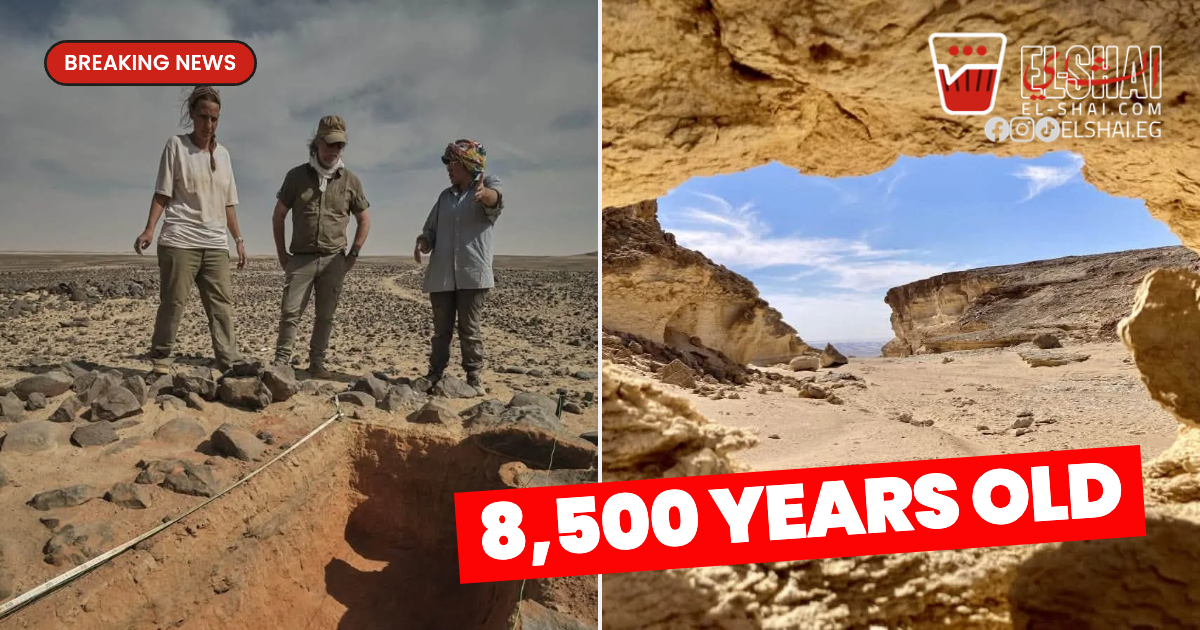
An extensive prehistoric settlement in Farafra dating back roughly 8,500 years has been uncovered on the Rajih Plateau by a joint Egyptian-Italian archaeological team, the Ministry of Tourism and Antiquities announced.
The discovery was made by the Farafra Oasis Prehistoric Project (FOPP) in collaboration with the Supreme Council of Antiquities, expanding field research in an area of Egypt’s Western Desert that remained largely unexamined until systematic surveys began in 2023.
Read also: Netflix Unravels Ancient Egyptian Discoveries in Official Trailer of “Unknown: The Lost Pyramid”
Prehistoric Settlement in Farafra Yields 200 Structures
The settlement, designated Site 1, sits on the Rajih Plateau along the eastern rim of the Farafra depression. Field teams mapped roughly 200 archaeological features, including stone foundations, hearths, and concentrated spreads of knapped stone tools.
According to preliminary assessments by the mission, the spatial layout points to deliberate, structured community living rather than a temporary campsite used by passing pastoralists.
The findings place the active phase of the settlement in the mid-Holocene, around 6500 BCE, an era when the wider Sahara received periodic monsoon rainfall.
How Ancient Lakes Sustained Life in the Sahara
The presence of an organized prehistoric settlement in Farafra makes little sense under today’s hyper-arid conditions, but geological testing carried out by the team paints a radically different environmental picture.
Surveys identified sedimentary deposits from ancient, shallow freshwater lakes that once pooled across the plateau’s natural depressions. The local geology also provided limestone and chert, which inhabitants quarried on site to construct domestic shelters and craft utilitarian tools.
Dr. Hisham El-Leithy, Secretary-General of the Supreme Council of Antiquities, noted that the distribution of hearths and discarded tools indicates ongoing domestic activities, demonstrating that communities remained on the plateau over generations.
Tracing Connections Across the Western Desert
Fieldwork on the Rajih Plateau began relatively recently in 2023, targeting high-elevation areas that had never undergone systematic excavation, explained Mohamed Abdel-Badei, Head of the Ancient Egyptian Antiquities Sector. The 2025 field season expanded this work into comprehensive topographic mapping, photography, and artifact analysis.
Mission director Dr. Giulio Lucarini explained that comparative studies helped establish the site’s initial dating. Artifact forms and stone-working techniques match material previously excavated in Farafra’s Wadi El-Obeiyid, as well as prehistoric sites across the neighboring Dakhla and Kharga oases.
The plateau site directly expands upon earlier surveys conducted around the Rajih plains and Bir Mur at the base of the limestone escarpment, where past human occupation was similarly tied to fossil lake beds.
Read also: Dr. Zahi Hawass announces a new surprise for those who are in love with the Egyptian Culture
Why Desert Prehistory Demands Attention
Dynastic temples and royal tombs dominate popular perceptions of Egyptian archaeology, but sites like the prehistoric settlement in Farafra document the groundwork of human adaptation in northeast Africa.
As the African Humid Period waned and the Western Desert dried out over thousands of years, these organized oasis populations were forced to migrate toward the Nile Valley, carrying developed social structures, pastoral techniques, and tool technologies with them.
Dr. Barbara Barich of the Farafra Oasis Prehistoric Project confirmed that research on the plateau will continue in coordination with the Dakhla Antiquities Inspectorate, aiming to map how these early desert societies adapted to catastrophic environmental drying.