


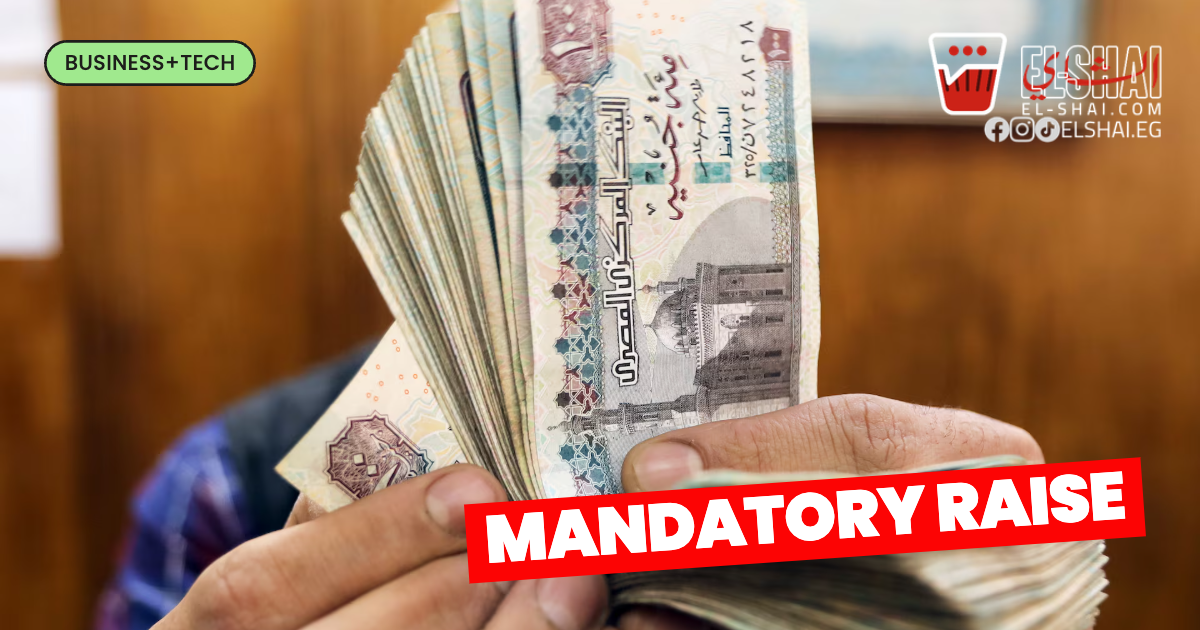
Egypt’s National Council for Wages has approved raising the private sector minimum wage to EGP 8,500 gross per month starting January 1, 2027, up from the current EGP 7,000 baseline.
The decision came during a Sunday meeting chaired by Prime Minister Mostafa Madbouly alongside government ministers and business federation heads, impacting approximately 26.5 million workers who make up more than 80% of Egypt’s overall employment force under the new private sector minimum wage framework.
How the New Private Sector Minimum Wage Works in Practice
The decision to raise the private sector minimum wage does not mean everyone receives a blanket EGP 1,500 raise across the board. Instead, the National Council for Wages is setting a baseline floor below which no formal private-sector salary can legally fall.
Workers currently earning EGP 7,000 will see an increase of EGP 1,500 per month starting with their January 2027 paychecks. Someone currently making EGP 7,500 will receive a EGP 1,000 adjustment, while an employee earning EGP 8,000 will see a EGP 500 bump to reach the required threshold.
For employees whose gross monthly pay is already EGP 8,500 or higher, the mandate triggers no mandatory automatic raise. Any pay bump for those workers remains governed strictly by internal company policies and individual employment contracts.
What You Will Actually Take Home After Deductions
Gross numbers rarely match what shows up in a bank account on payday. While the baseline salary is set at EGP 8,500, mandatory deductions for personal income taxes and social insurance contributions will reduce that final payout.
According to Eng. Alaa El-Sakty, head of the SME Investors Union and a member of the National Council for Wages, an employee earning the new baseline can expect a net monthly take-home pay between EGP 7,000 and EGP 7,500 depending on the specific deductions applied to their bracket.
El-Sakty stated that the 21.4% increase in the baseline wage outpaces the national inflation rate of roughly 14%, offering practical relief to workers even as small and medium businesses balance rising operational and production overheads across Egypt’s estimated four million commercial enterprises.
New Rates for Hourly, Part-Time, and Annual Raises
The council’s decisions also extended past full-time monthly salaries to cover temporary, seasonal, and part-time staff across Egyptian private businesses.
The official minimum hourly rate for part-time and temporary work has climbed from EGP 28 to EGP 34 net, marking a six-pound increase per hour. According to Labor Ministry spokesperson Abdel Wahab Khedr, an individual working four hours daily for 26 days a month is entitled to no less than EGP 3,536 monthly.
The council also established an updated baseline for the mandatory annual periodic raise, setting the minimum at EGP 350, on the condition that it represents no less than 3% of the social insurance subscription wage starting in fiscal year 2027.
What to Do if Your Employer Refuses to Pay
Compliance with the updated private sector minimum wage is legally mandatory across all private sector facilities without exemption, according to Khedr. Article 104 of Labor Law No. 14 of 2025 obligates commercial establishments to implement National Council for Wages decisions in full.
Under Article 105 of the same law, employers must maintain clear records showing employee data and wages disbursed, which ministry inspection teams review during routine audits. Establishments caught paying below the legal floor face financial penalties that multiply with each repeated violation.
If your paycheck does not reflect the required adjustment come January 2027, the Ministry of Labor advises following a clear sequence of steps rather than waiting out the issue silently.
- Review your contract and raise the issue directly with your human resources or payroll department to request wage settlement under the new council decision.
- Gather your paper trail, including your original employment contract, recent pay stubs, and formal bank transfer receipts.
- File a formal complaint at the competent labor office affiliated with your governorate’s Labor Directorate if internal channels refuse to correct your salary.
The Broader Shift Behind Egypt’s Wage Policy
The National Council for Wages also established a joint working committee bringing together state officials and private enterprise leaders to study wage adjustments and income trajectories through 2030.
Passing wage mandates on paper is one thing; enforcing them across a fragmented landscape of millions of small workshops and service businesses is entirely another. The Labor Ministry will distribute a binding periodic circular to provincial directorates to step up field inspections.
For employees on the ground, the immediate test arrives in January 2027. Keep your contracts and pay stubs organized, monitor your company’s pay bracket adjustments, and hold employers to the letter of the law.
Read Next.
 Business+Tech
Meet LemFi, the Global Financial Platform That Just Got a Major Upgrade
 Business+Tech
How to Make Your Car Smarter Instead of Replacing It, According to Badr El Din Automotive Accessories & Tuning
 Business+Tech